Impellor Group

Turning Expertise into Growth

Call 877.358.8413


  • Welcome
  • For Accounting Firms
    • Client Advisory Capability Lab
    • Constructive Client Conversations
    • Proposal Mastery
    • Rainmaker Mentor
    • Speaking
  • About
  • Contact
  • Insights

14 Essential Skills to Thrive as a Successful Seller-Doer

December 18, 2024 by Jim Rogers

In today’s competitive business landscape, the seller-doer role is becoming increasingly vital in professional services. As a professional in your field, whether accounting, architecture, engineering, consulting, or law, your ability to seamlessly integrate business development with project execution can set you apart from your peers. However, excelling in this dual role requires a diverse set of skills.

In this blog, I will share 14 essential skills that will equip you with the tools and insights needed to thrive as a successful seller-doer. Whether you’re just starting or looking to enhance your capabilities, these skills are the building blocks for your career success.

Skill #1: Relationship Building. 

While conducting research for my book, Becoming a Seller-Doer: Succeed at Business Development and Take Command of Your Career, I surveyed over 1,200 A/E/C professionals across various industries. Relationship building topped both our surveys (one quantitative and the other qualitative) as the most important skill for seller-doer success. 

With that being said, take the time to build rapport with your clients through verbal and nonverbal communication, active listening, social awareness, and etiquette.

Skill #2: Public Speaking. 

The fastest and most effective way to become a better speaker is to do it. A successful seller-doer understands how to deliver a range of effective talks, such as project presentations, technical education sessions, and webinars. Toastmasters is an organization devoted to developing public speaking and leadership skills.

Skill #3: Business Writing.

Our definition of business writing skill is “The ability, in a corporate setting, to write clearly to inform or persuade.” To achieve success as a seller-doer, you don’t have to become a stellar writer—it will suffice to write clearly and concisely. Currently, Grammarly is the best tool for improving your writing. It even explains it’s recommendations. If you’re using AI to help you write, beware: most generative AI tools are subpar at grammar, which creates clarity.

Skill #4: Storytelling.

Tell stories that engage and influence the listener. Storytelling is essential in marketing and business development. Can you tell your story and your firm’s at a networking event, during a business development call, or in a project meeting? These are all places where selling “happens.”

Skill #5: Market & Client Research.

Acquire Industry Knowledge: Stay updated on the latest trends, innovations, and challenges within your industry. 

Gather Client Intelligence: Gain deep insights into your clients’ businesses, needs, and pain points. This includes understanding their goals, strategies, and decision-making processes. 

Gain Competitor Understanding: Analyze your competitors to identify their strengths and weaknesses. This knowledge allows you to differentiate your services and highlight your unique value propositions.

Skill #6: Capture Planning.

Create a plan for acquiring client business. The key is to follow a process of inquiry that will help you decide whether to spend time and treasure in pursuit of a particular contract. When pursuing major accounts, an account pursuit plan is invaluable. If you want templates for capture plans, send me an email: jim@sellerdoeracademy.com

Skill #7: Making Go/No-Go Decisions.

Distinguish worthwhile client pursuits from poor ones. Experienced managers will be expected to have the business acumen and self-awareness to use their understanding of the client, the industry, and the competitive landscape.

Skill #8: Internet Marketing & Networking.

Merriam-Webster defines networking as “the cultivation of productive relationships for employment or business.” This definition works nicely because it is situation-independent and ignores the activity’s medium. You can develop productive relationships at business association meetings while “working the room,” but you can also build relationships by being active on LinkedIn. Use the internet to increase your visibility, build authority, and engage with prospects and clients.

Skill #9: Prospecting.

Find, qualify, and pursue leads for new clients. Think of prospecting this way: It’s your effort to generate leads for new clients through networking, referrals, and proactive phone calls.

Skill #10: Questioning.

Questioning is the process of discovering client needs and wants. Ask effective questions that uncover client needs and preferences. Don’t think of it as selling; think of it as discovery. The art and science of questioning also help a client feel heard and valued.

Skill #11: Positioning.

The act of positioning is to stake out territory in the client’s mind about your attributes and strengths and how they will benefit by working with you. Communicate your firm’s capabilities, markets served, accomplishments, and value proposition.

Skill #12: Proposal Writing.

While all business writing demands writing with clarity, proposal writing is sales writing. It is about convincing decision-makers that you are the best fit for a particular project. Write proposals and letters that close business.

Skill #13: Interview Presentations.

Mastering interview presentations is crucial for winning over clients during short-list interviews. Customize your presentation to address the client’s specific needs and concerns. Clearly articulate your value proposition and highlight the benefits and outcomes the client can expect from working with you. Present your ideas confidently and clearly. Use compelling storytelling techniques to connect with your audience and make your message memorable.

Skill #14: Negotiation.

When closing contracts with clients, much of that responsibility will fall on the principal, who must put their imprimatur on the contract; however, they will rely on the other senior project members to help. Agree on mutually beneficial terms to be formalized in a contract.

Mastering these 14 essential skills will not only equip you to thrive as a seller-doer but will also position you as a key player in your firm’s business development efforts. The ability to build relationships, communicate effectively, and strategically navigate the business landscape is what sets successful seller-doers apart. 

By focusing on these skills, you can take command of your career and make a significant impact on your firm’s growth and success. Embrace the journey of continuous learning and skill development, and watch your career soar to new heights.

Interested in learning more about becoming a successful seller-doer?

Purchase my book on Amazon!

Filed Under: Business Development, Communication, Engineering, Generate Leads, Keep Clients, Networking

6 Key Attributes of Successful Seller-Doers in Professional Services: Insights from Industry Leaders

October 26, 2024 by Jim Rogers

Professional success in professional services industries is often attributed to a combination of technical expertise and personal attributes that set certain professionals apart. After interviewing over 40 highly successful individuals in professional services, some common traits emerged as critical to their achievements. 

These attributes aren’t just buzzwords; they are qualities that shape how these professionals approach their work, build relationships, and ultimately thrive in their careers. Let’s delve into six of these key attributes.

Attribute #1: Passion

“Clients like passion. They want to be around you when you’re passionate, so find something that you’re interested in. Whether it’s the social aspect, or whether it’s the equipment, or whether it’s the technical papers, get into it. Stop dwelling on stuff that you don’t like and find something that you do like.” -Jeff Berk, PE, principal at engineering firm GHD

Attribute #2: Caring

The Oxford English Dictionary defines caring as “to feel concern or interest.” You can’t become a successful seller-doer without building lasting client relationships. 

“My father and my mom used to say, ‘In order for you to succeed, we want you to be an A-student in society, and it’s okay to be a B-student in schooling.’ Be good with people.” -Saiid Behboodi, PE, principal of PBS Engineering & Environmental

Attribute #3: Ownership

With an owner mindset, you assume responsibility for finding opportunities to learn, sell, partner, and help clients. You take ownership of client relationships and the business’s success no matter what.

This sense of ownership and responsibility is why Dave DeLizza of Pennoni once traveled several hours through a severe snow and ice storm to meet with a potential client and his team. Almost 30 years later, Pennoni is still working for that client.

Attribute #4: Confidence

Confidence is the quiet assuredness that you know your stuff, can build relationships with people, and can win them over. Confidence begins with self-respect and authenticity.

People can tell the difference between authentic confidence and bravado. It was a lesson Laura Wernick at HMFH learned early: “I was trying so hard to be this perfect salesperson that I wasn’t perceived as being genuine.”

Attribute #5: Persistence

If you are never faced with fear or doubt in your career, then you’re not pushing through your barriers. If becoming a seller-doer were easy, then every engineering professional would be one.

“I remember a statistic from SMPS that said it takes seven outreaches before you finally connect with somebody new. And most people give up after the first one. Until they say, ‘Quit bugging me,’ keep calling.” -Judy Nitsch, retired founder of Nitsch Engineering

Attribute #6: Assertiveness

Being assertive is vastly different from being aggressive. Assertive people look for opportunities rather than waiting for opportunities to be presented to them.

“We were opening Florida offices, and our executive team was going to walk the halls and study org charts to figure out who to send. I offered another way to select those who want to help us expand and said, ‘Why don’t we put out a call and ask? Let’s see who raises their hand.’ Similarly, when it’s time to look for our next business developers, I watch for those who raise their hands. They tend to have their antennae up for opportunities”. -John Mick

The road to success in the A/E/C industry is paved with more than just technical and communication skills. Personal characteristics and attitudes matter. By cultivating these traits, you enhance your personal development and position yourself as a key player in the industry.

Interested in learning more about becoming a successful seller-doer?

Click here to get my book on Amazon!

Filed Under: Architecture, Business Development, Engineering, Keep Clients, Leadership

Understanding the Client Life Cycle from THEIR Viewpoint

September 26, 2024 by Jim Rogers

Understanding the nuances of client relationships is crucial for business development. In training programs at the Seller-Doer Academy, a recurring theme is: It’s not about you (the consultant); it’s about them (the client). Participants learn to recite the mantra, “It’s not about me; it’s about you.” 

When we think about seller-doer activities, we use the terms marketing, business development, and perhaps even (gasp!) sales. Those terms reflect our perspective of what we need to do to gain clients. However, it is useful to consider the client lifecycle from their perspective of what they need- a demand-side view rather than a supply-side view. 

Let’s explore the five stages of the client life cycle from the demand side and how to strategically align your activities with each stage to maximize your business development success.

Stage #1: Awareness

At this stage, potential clients are just learning about your firm. Your goal is to increase visibility and establish your presence in the industry. Activities include networking, social media engagement, and thought leadership. You establish thought leadership by writing articles or blogs and delivering presentations at conferences or private lunch-and-learns. 

Stage #2: Interest

Once you have a potential client’s attention, the focus shifts to sparking their interest in your services. Share case studies, success stories, and insights that showcase your expertise and how you can solve their problems. When they see that you have helped other firms like theirs, they will comprehend that you can help them, too. 

Stage #3: Consideration

At this stage, potential clients evaluate whether to work with your firm. Perhaps they invite you to talk to them in detail about a particular project or ask you for a proposal so they can weigh you against their other options. 

Stage #4: Selection

Congratulations! They’ve selected you to help them achieve their project goals. 

Stage #5: Commitment

Once working with a client, it’s your job to keep them. Deliver exceptional results, maintain regular communication, and seek feedback to ensure satisfaction and continuous improvement. Commit to the care and nurturing of the people within the organization because organizations don’t make decisions; people in organizations make decisions.

Understanding the client’s lifecycle from the client’s perspective and what you need to do to satisfy their needs at each stage helps direct your activities to build and sustain the relationship.

Interested in learning more about becoming a successful seller-doer?

Click here to purchase my book on Amazon!

Filed Under: Architecture, Business Development, Communication, Engineering, Generate Leads, Keep Clients, Sales

Creating a Service-Driven Culture

January 25, 2023 by Jim Rogers

Steve Osborn, P.E. Founding Principal, CE Solutions

One of the 44 executives I interviewed for the book, Steve Osborn, Founding Principal at CE Solutions, Inc., discussed how he has created and continued to sustain a service-driven culture within his company. This post is an excerpt from my interview with Steve. 


Jim: What do you do within your firm to instill your values within your employees? 

Steve Osborn: I’ve been lucky because I started the firm from scratch by myself and have been able to grow it organically. The hiring process is probably the most important thing we do since we’re a service provider. It’s important to have that culture — that foundational philosophy and those principles instilled in people when they come on board here. Our recruiting process is very intentional.

During the interview process, we talk a lot about what our firm is like, what’s important to us, what our foundational principles are, what our brand attributes are, and how we deliver service. We can tell by listening to people if they align with us. We look for the character values and attributes that we want. We’ve had really good success with that.

We create a lot of opportunities for those individuals to grow quickly. We involve them in client contact and give them all the responsibilities of project management upfront. The only thing that they don’t have is experience — but they have all of the other qualities that we’re looking for in a strong project manager. So we allow them to manage their own projects under the supervision of an experienced senior professional.

They can then be responsible for their work. We develop and prepare them. By the time they’re ready to take their PE exam, they’re very comfortable, prepared, and have a high success rate of passage. Then they get their own projects and fly solo after that.

Our clients have complimented us on that approach. They think it’s pretty unique that we give young individuals that many opportunities at an early age. They enjoy working with them as well. The young professionals are the point of contact, but they know they’ve got the senior guy next to them. Our young people get excited about that opportunity.

Filed Under: Architecture, Business Development, Engineering, Keep Clients, Leadership, Seller-Doer

The Importance of Exceptional Client Service

January 11, 2023 by Jim Rogers

One of the 44 executives I interviewed for the book, Steve Osborn, Founding Principal at CE Solutions, Inc., spent the most time talking about what it means to deliver exceptional service to clients — and how that helps you build your business. This post is an excerpt from my interview with Steve. 


Jim: Steve, you’ve been very methodical and intentional about what you do to ensure your folks deliver great client service. Could you tell me about that?

Steve Osborn: Absolutely. Happy to do that. The idea behind starting my firm 19 years ago was based on four foundational principles: strong relationships, mutual respect, integrity, and ethical practice. It’s how we operate and make decisions daily. It’s how we have grown the business and determines everything we do, from the hiring process to who we do business with – I’m very much a relationship person. I’m very interested in the business of the business, as well as the profession of structural engineering that we serve. 

As a result of being a relationship person, I’m also a very caring person, and I want to be able to take good care of the people that entrust us with their projects. I can’t over-emphasize how important real effective communication is in our business. It involves keeping our clients informed of the progress that we’re making on their projects regularly. I don’t like when our clients have to contact us and ask about the status of something. I like being proactive in keeping them informed. It’s important to me that we hire people with similar characteristics because I feel those are the kind of things that are difficult to teach someone. It’s also about doing business with people we know and trust — people who care about and respect us as well.

Jim: Can you give me an example?

Steve Osborn: Sure. We’re proactive in terms of providing regular updates on the projects. Before they ask, we give it to them. We get nice feedback and are complimented all the time about that. Clients say, “We always ask that of somebody, but we don’t always get it.”

Another good example is the level of completeness of our documents. We produce and deliver them in the timeframe that we promise. We get complimented all the time about coming to progress meetings which are intended to discuss 50% completion, and we bring documents that are 75% complete. The clients notice that. 

Another thing we’ve done is deliver projects ahead of schedule. We’ve delivered projects two to four weeks ahead of schedule — and sometimes when we’re prime, it allows them to put it on an earlier bid letting. In one case with one of our institutional clients, our project was scheduled for a bid letting towards the end of the year, so it was jammed. They had a lot of projects going on in that bid letting, so they were worried about getting good competitive pricing. We were able to deliver the project several weeks ahead of time, which put it on an earlier letting — which had less competition for projects going out. As a result of that, they felt they got better pricing.

Jim: That’s a great example of an outcome a client gets from that kind of service.

Steve Osborn: In a follow-up, even the client commented when we did that. They said that this is unheard of. They had never experienced that before with somebody, so I felt like it set us apart. It was kind of surprising that nobody has done or offered that. I remember them specifically saying, “Nobody does this. This is incredible.” It was a nice thing to hear.

I tell my staff all the time — “You never know where your opportunities will come from. Just go out there and be sincere. Be yourself. Don’t be shallow. Don’t be artificial. Don’t just go through the motions. You have to be real. You have to be who you are.” That’s why we consider those characteristics during the hiring process. We try to hire people who truly care.

Filed Under: Architecture, Business Development, Engineering, Keep Clients, Leadership, Seller-Doer

How to Market Your Firm During the Coronavirus Crisis . . . Without Shame

March 22, 2020 by Jim Rogers

Hundred Dollar Bill with Benjamin Franklin in Coronavirus Protective Mask

Right now, as you try to find your footing in the time of the Covid19 pandemic, you may consider marketing and sales to be insensitive or distasteful—but it doesn’t have to be.

It’s vital that you shore up your business—now—before your competitors do a better job of it. This is a justifiable time to protect your client relationships and to position yourself in the market without feeling guilt or shame. To actively do so isn’t opportunistic—it’s simply good client service and good business.

On the other hand, hoarding 17,000 bottles of hand sanitizer and trying to gouge consumers is shameful and criminal.

Marketing during a crisis is about maintaining and deepening relationships with clients. Yet that effort requires a delicate touch.

The key to delicate touch is just to:

  1. Show that you care
  2. Share knowledge that helps clients work better, faster, and cheaper during the crisis.

To read specific suggestions for how to market your firm, confidently and without shame, click here for the PDF.

Then click here to send me an email and tell me what you thought of it.

Be well and be safe. Jim

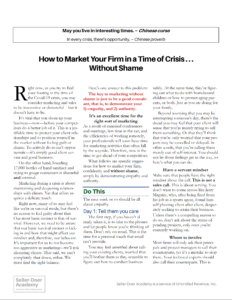
Report cover How to Market Your Firm During Coronavirus Crisis without Shame

Marketing Professional Services Without Shame During a Crisis (by Jim Rogers) revised

Filed Under: Accounting, Business Development, Communication, Construction, Generate Leads, Keep Clients, Professional Services Marketing, Sales, Seller-Doer

Copyright © 2026 by Impellor Group, Inc. · (877) 358-8413