Impellor Group

Turning Expertise into Growth

Call 877.358.8413


  • Welcome
  • For Accounting Firms
    • Client Advisory Capability Lab
    • Constructive Client Conversations
    • Proposal Mastery
    • Rainmaker Mentor
    • Speaking
  • About
  • Contact
  • Insights

14 Essential Skills to Thrive as a Successful Seller-Doer

December 18, 2024 by Jim Rogers

In today’s competitive business landscape, the seller-doer role is becoming increasingly vital in professional services. As a professional in your field, whether accounting, architecture, engineering, consulting, or law, your ability to seamlessly integrate business development with project execution can set you apart from your peers. However, excelling in this dual role requires a diverse set of skills.

In this blog, I will share 14 essential skills that will equip you with the tools and insights needed to thrive as a successful seller-doer. Whether you’re just starting or looking to enhance your capabilities, these skills are the building blocks for your career success.

Skill #1: Relationship Building. 

While conducting research for my book, Becoming a Seller-Doer: Succeed at Business Development and Take Command of Your Career, I surveyed over 1,200 A/E/C professionals across various industries. Relationship building topped both our surveys (one quantitative and the other qualitative) as the most important skill for seller-doer success. 

With that being said, take the time to build rapport with your clients through verbal and nonverbal communication, active listening, social awareness, and etiquette.

Skill #2: Public Speaking. 

The fastest and most effective way to become a better speaker is to do it. A successful seller-doer understands how to deliver a range of effective talks, such as project presentations, technical education sessions, and webinars. Toastmasters is an organization devoted to developing public speaking and leadership skills.

Skill #3: Business Writing.

Our definition of business writing skill is “The ability, in a corporate setting, to write clearly to inform or persuade.” To achieve success as a seller-doer, you don’t have to become a stellar writer—it will suffice to write clearly and concisely. Currently, Grammarly is the best tool for improving your writing. It even explains it’s recommendations. If you’re using AI to help you write, beware: most generative AI tools are subpar at grammar, which creates clarity.

Skill #4: Storytelling.

Tell stories that engage and influence the listener. Storytelling is essential in marketing and business development. Can you tell your story and your firm’s at a networking event, during a business development call, or in a project meeting? These are all places where selling “happens.”

Skill #5: Market & Client Research.

Acquire Industry Knowledge: Stay updated on the latest trends, innovations, and challenges within your industry. 

Gather Client Intelligence: Gain deep insights into your clients’ businesses, needs, and pain points. This includes understanding their goals, strategies, and decision-making processes. 

Gain Competitor Understanding: Analyze your competitors to identify their strengths and weaknesses. This knowledge allows you to differentiate your services and highlight your unique value propositions.

Skill #6: Capture Planning.

Create a plan for acquiring client business. The key is to follow a process of inquiry that will help you decide whether to spend time and treasure in pursuit of a particular contract. When pursuing major accounts, an account pursuit plan is invaluable. If you want templates for capture plans, send me an email: jim@sellerdoeracademy.com

Skill #7: Making Go/No-Go Decisions.

Distinguish worthwhile client pursuits from poor ones. Experienced managers will be expected to have the business acumen and self-awareness to use their understanding of the client, the industry, and the competitive landscape.

Skill #8: Internet Marketing & Networking.

Merriam-Webster defines networking as “the cultivation of productive relationships for employment or business.” This definition works nicely because it is situation-independent and ignores the activity’s medium. You can develop productive relationships at business association meetings while “working the room,” but you can also build relationships by being active on LinkedIn. Use the internet to increase your visibility, build authority, and engage with prospects and clients.

Skill #9: Prospecting.

Find, qualify, and pursue leads for new clients. Think of prospecting this way: It’s your effort to generate leads for new clients through networking, referrals, and proactive phone calls.

Skill #10: Questioning.

Questioning is the process of discovering client needs and wants. Ask effective questions that uncover client needs and preferences. Don’t think of it as selling; think of it as discovery. The art and science of questioning also help a client feel heard and valued.

Skill #11: Positioning.

The act of positioning is to stake out territory in the client’s mind about your attributes and strengths and how they will benefit by working with you. Communicate your firm’s capabilities, markets served, accomplishments, and value proposition.

Skill #12: Proposal Writing.

While all business writing demands writing with clarity, proposal writing is sales writing. It is about convincing decision-makers that you are the best fit for a particular project. Write proposals and letters that close business.

Skill #13: Interview Presentations.

Mastering interview presentations is crucial for winning over clients during short-list interviews. Customize your presentation to address the client’s specific needs and concerns. Clearly articulate your value proposition and highlight the benefits and outcomes the client can expect from working with you. Present your ideas confidently and clearly. Use compelling storytelling techniques to connect with your audience and make your message memorable.

Skill #14: Negotiation.

When closing contracts with clients, much of that responsibility will fall on the principal, who must put their imprimatur on the contract; however, they will rely on the other senior project members to help. Agree on mutually beneficial terms to be formalized in a contract.

Mastering these 14 essential skills will not only equip you to thrive as a seller-doer but will also position you as a key player in your firm’s business development efforts. The ability to build relationships, communicate effectively, and strategically navigate the business landscape is what sets successful seller-doers apart. 

By focusing on these skills, you can take command of your career and make a significant impact on your firm’s growth and success. Embrace the journey of continuous learning and skill development, and watch your career soar to new heights.

Interested in learning more about becoming a successful seller-doer?

Purchase my book on Amazon!

Filed Under: Business Development, Communication, Engineering, Generate Leads, Keep Clients, Networking

7 High-Impact Ways to Activate and Energize Seller-Doers in Your Firm

November 25, 2024 by Jim Rogers

In the professional services industries, empowering your team to embrace the role of a seller-doer is essential for driving business growth. However, keeping these professionals motivated and engaged requires thoughtful and intentional leadership. 

Today, I’m sharing seven high-impact strategies for you and other leaders in your firm to help activate your seller-doers and keep them actively contributing to your business development efforts.

1. Be a sherpa. 

The Sherpas of Tibet are the best mountain climbers in the world and get hired to help climbers make their way to the top of Mount Everest. But they don’t just lead you up the trail and carry the load—they ensure you’re fully equipped for the climb and have the resources and guidance you need, especially if you get into trouble. As a leader, you must adopt the same mindset. Equip your seller-doers with the tools, knowledge, and support they need to navigate the challenges they’ll encounter on their path to success.

2. Spark their desire using the 5 Rs of leadership.

Regard: Notice and take an interest in what they’re doing.

Recognize: Give them a public shout-out for stepping up.

Reward: Think beyond advancement and financial rewards. Rewards proven to motivate employees include access to training, job rotation, or supporting a fundraiser for the employee’s favorite charity.

Reinforce: Stress the importance of their work for the firm. Schedule a one-on-one to give them a quick pat on the back. 

Remind: Renew the idea that they’re taking command of their careers and get to choose what they want from it. Whether they want to ascend within the firm or remain an independent contributor, they will grow their influence if they can help bring in business.

3. Build their belief.

To succeed as seller-doers, your employees must believe in themselves—which means that you have to believe in them first. Demonstrating your confidence in their abilities helps them build the self-assurance they need to succeed in their roles.

4. Develop their ability.

Training is part of building seller-doer skills. However, training is an event; learning is a process. Commit to longer timelines for skill development to reinforce training and learn skills unsuitable for the classroom. Utilize experiential learning, feedback, delegation, shadowing, and sending them to industry conferences.

5. Foster their perseverance. 

To foster perseverance, allow people to fail. When we ignore our own selfish desire for convenience and help others learn and grow, it enriches their lives, our lives, our companies, and the world… a thousand times over.

6. Remove a barrier of perception. 

One barrier to activating more seller-doers may be the “doer’s” perception that advancement is the primary reason to be a seller-doer. To activate more seller-doers, you’ll need to find ways to decouple success at business with career hierarchy.

7. Help them take command.

Show your people that the opportunity to become a seller-doer exists. Then, encourage and enable them to acquire the desire and belief to succeed, offer support and resources for them to develop their ability as a seller-doer, and allow them to stumble and make mistakes so they will continue to persevere in their quest to add greater value to your firm — and find greater fulfillment in their careers.

Activating and sustaining the energy of your seller-doers is a continuous process that requires dedicated leadership. Embrace these strategies, and watch your team — and your firm — reach new heights.

Interested in learning more about becoming a successful seller-doer?

Click here to get your copy of “Becoming a Seller-Doer” on Amazon!


Filed Under: Business Development, Generate Leads, Leadership

Understanding the Client Life Cycle from THEIR Viewpoint

September 26, 2024 by Jim Rogers

Understanding the nuances of client relationships is crucial for business development. In training programs at the Seller-Doer Academy, a recurring theme is: It’s not about you (the consultant); it’s about them (the client). Participants learn to recite the mantra, “It’s not about me; it’s about you.” 

When we think about seller-doer activities, we use the terms marketing, business development, and perhaps even (gasp!) sales. Those terms reflect our perspective of what we need to do to gain clients. However, it is useful to consider the client lifecycle from their perspective of what they need- a demand-side view rather than a supply-side view. 

Let’s explore the five stages of the client life cycle from the demand side and how to strategically align your activities with each stage to maximize your business development success.

Stage #1: Awareness

At this stage, potential clients are just learning about your firm. Your goal is to increase visibility and establish your presence in the industry. Activities include networking, social media engagement, and thought leadership. You establish thought leadership by writing articles or blogs and delivering presentations at conferences or private lunch-and-learns. 

Stage #2: Interest

Once you have a potential client’s attention, the focus shifts to sparking their interest in your services. Share case studies, success stories, and insights that showcase your expertise and how you can solve their problems. When they see that you have helped other firms like theirs, they will comprehend that you can help them, too. 

Stage #3: Consideration

At this stage, potential clients evaluate whether to work with your firm. Perhaps they invite you to talk to them in detail about a particular project or ask you for a proposal so they can weigh you against their other options. 

Stage #4: Selection

Congratulations! They’ve selected you to help them achieve their project goals. 

Stage #5: Commitment

Once working with a client, it’s your job to keep them. Deliver exceptional results, maintain regular communication, and seek feedback to ensure satisfaction and continuous improvement. Commit to the care and nurturing of the people within the organization because organizations don’t make decisions; people in organizations make decisions.

Understanding the client’s lifecycle from the client’s perspective and what you need to do to satisfy their needs at each stage helps direct your activities to build and sustain the relationship.

Interested in learning more about becoming a successful seller-doer?

Click here to purchase my book on Amazon!

Filed Under: Architecture, Business Development, Communication, Engineering, Generate Leads, Keep Clients, Sales

Four Keys to Harness AI to Be More Competitive

January 18, 2024 by Jim Rogers


artificial intellegence

If you’re interested in learning how to harness the power of artificial intelligence to make your engineering or architecture firm more competitive, this post will give you the four keys to success. 

Lately, my clients have asked me about artificial intelligence. Although I’m not an AI technologist, I gave them some good advice I’ll share in this post. That’s because, for 25 years, I was an organizational change management (OCM) consultant. OCM is a specific discipline in the software implementation industry. An OCM consultant’s job is to help company leaders get their people to assimilate new information technology, processes, and best practices to become more competitive.

I’ve taken my 25 years of experience as an OCM consultant and applied it to the unique challenge of assimilating AI, so here are the four keys to AI success:

  1. Ready your organization for the new pace of change,
  2. Optimize your knowledge sharing across the firm,
  3. Get your house in order regarding data hygiene and
  4. Mobilize a quick-strike AI task force.

Learn to Lead Change in a Fast-Paced Environment

First, success with AI isn’t merely about technology but rather the ability to be nimble, given the breakneck pace of change we’re about to experience. In this world, your only source of sustainable competitive advantage will be to be more agile than your competitors – to “outlearn” them. That means being able to lead change from the top. 

Traditionally, A/E firms have thrived without urgently adopting the latest technologies – you could take a wait-and-see attitude and move at your own pace. It will be impossible to do that with artificial intelligence. Professional services firms are getting benefits from it now. If you wait until 2025 to figure it out, you’re not going to be one year behind; you’re going to be three years behind. So, leading change and overcoming resistance will be the key to success. 

To be agile, leaders and managers must learn the framework for leading change. The field-tested methodology created 20 years ago, the ADKAR model for leading change, includes tools and templates. We’ve adapted their tools to develop a playbook for A/E firms to adopt AI. Suppose your firm hasn’t trained leaders and managers to implement strategic change. In that case, you must develop this capability to succeed in the new, lightning-fast business world that AI, such as ChatGPT, has already ushered in. Part of the leader’s job will be to foster a more collaborative culture, where people are willing to share ideas for the company’s tremendous success rather than hoard knowledge to make themselves more indispensable.

Knowledge Sharing Processes and Systems Are Essential

The second key is to optimize your knowledge sharing throughout the firm, whether using collaborative workspaces like Microsoft Teams and SharePoint or other third-party software to help with knowledge management. Information systems are essential to knowledge sharing, as are people – in the form of a community of practice. 

A community of practice (CoP) is a group of people who share a common interest or concern and learn how to do something better through regular interaction. I’ve created seller-doer communities of practice within my client organizations to reinforce the training that they’ve received through the Academy. You’re going to need an AI community of practice. Hang on to that thought because I’ll talk about your task force getting started here in a minute. 

Once you’ve developed and tested new applications, you must be able to deploy them quickly; thus, knowledge sharing will be vital.

Data Integrity and Completeness

Third, if you haven’t heard the phrase ‘garbage in, garbage out,’ you’re getting ready to hear it a lot. If your house is not in order regarding data, you will get garbage out of AI, and people will get frustrated and not want to use it. So now is a perfect time to do some data cleanup; ensure it’s thorough, accurate, and structured in a helpful way for AI. The data may be in your ERP, CRM, data warehouses, or even PDFs in SharePoint. Without clean data, people will bang their heads against the wall and give up. Or worse, poor data will yield wrong answers and create problems for your company. So, knowledge cleanup and data cleanup are critical pieces of this. 

Mobilize an AI Task Force

And fourth, mobilize a quick-strike AI task force. You may already have some informal pockets of activity in your organization – some you don’t know about. But there are good and bad ways to go about it. The bad ways will squander resources. The biggest enemy of your AI task force will be wasted time. You will have to put some of your best people on this. Some of these will be your most highly utilized people, maybe some of your highest people on your rate card. They’re going to be involved in figuring this out and rolling it out, and the most significant thing is What you don’t want to happen is for them to waste their precious time. If they waste time, it costs you money, it can create frustration or stress them out, create more organizational stress than is necessary, but that could lead to frustration and people abandoning trying to assimilate AI into your firm. And that’s going to be costly.

Again, an excellent, easy start this year without going whole hog is to get organized and define a process for taking on different applications of artificial intelligence, which will be a massive key to success.

Summary

So, here’s a quick recap:

  1. Learn the art and science of leading change,
  2. Optimize your knowledge-sharing systems and processes,
  3. Get your data cleaned up and organized, and
  4. Mobilize an AI Task Force to get jumpstarted without wasting time and money.

Those are the four keys to success. We have created a service offering likely to be available for only a year, so now’s the time to take advantage of it. It’s called the AI Jumpstart for A/E, and we’ll guide you through these four different keys to success and help you get organized and mobilized to start productively using AI and get it rolled out and assimilated through your organization.

The building blocks you put in place to become a more agile organization will be valuable: knowledge management system and clean data. All those things are of tremendous value, even outside the realm of artificial intelligence. You may have even been talking about change leadership, knowledge sharing, and data cleanliness for a long time. So the time to tackle them is now – you can’t put them off any longer. We’re here to help you with it with AI Jumpstart, which gets you going productively in just 90 days. Go to aijumpstart.ai to learn more about how we can help you roll out AI immediately.

Filed Under: Architecture, Engineering, Generate Leads

Drawing Younger, Less Experienced Staff into Marketing & Business Development

December 21, 2022 by Jim Rogers


One of the 44 executives I interviewed for the book, Laura Wernick, AIA of HMFH Architects in Boston, discussed how to support younger, less experienced staff in developing their networks and becoming involved in marketing and business development. This post is an excerpt from my interview with Laura.

Laura Wernick: It’s important for me to bring in opportunities or connect younger people in the office to help them build their networks. I’m often doing that initial introduction within the firm as a way of helping and then providing those leads to other people in the office.

They can then develop their networks and become marketers and business development people on their own. So that’s another end of the spectrum — making sure that others in the office have the opportunity to build networks and develop their prospects.

Jim Rogers: How do you know when people are ready to be more involved in business development?

Laura Wernick: I think some people are naturally inclined towards business development. They feel comfortable being introduced to people. They feel comfortable carrying on conversations and pursuing potential clients. So sometimes, it’s obvious.

There are other times when you’re trying to develop a person who may not see this as their forte, but you want to help them grow. So that’s probably the more challenging thing. That’s a little bit more of a push-and-pull situation. And I think it’s a gradual process.

The first layer is just getting them out to meet people in professional organization environments or community events and seeing how they respond, while providing feedback and encouragement. Hopefully, you’re able to push them into other situations and see how they respond at each level. Most architects are not inclined to do business development. They’d much prefer to sit at their desks and solve problems — solve the specific problem that’s handed to them.

So I think it’s about encouraging those with that natural inclination and giving them opportunities. And when do you know? I think that when you’re working with younger people on projects, on actually doing the design and following through with a project, and you see how they’re relating to the clients that they’re working with on a day-to-day basis — you begin to see those who can easily interact with their clients, lead their clients, and gain the confidence of their clients. So you know that those people are going to do well in the larger marketing environment. It just takes some encouragement, support, and opportunities for them to do well.

For other people, I think you just have to keep nurturing and nudging and building them up over time. And ultimately, not everyone will be able to do it easily. So you want to just help people to rise to their greatest potential.

Everybody has to be doing some level of marketing and business development; some people will do well at it, and others will just participate.

Filed Under: Architecture, Business Development, Engineering, Generate Leads, Leadership, Networking, Seller-Doer

Building Recognition for Your Authority

December 12, 2022 by Jim Rogers

Picture of woman with speaking to an audience at a conference.

Building your authority through speaking at professional and industry conferences.

In Becoming a Seller-Doer, I introduce the RLOCK model that reflects the five stages of the client lifecycle: Recognition, Lead, Opportunity, Close, and Keep. The R is about building recognition for your professional expertise and your firm’s brand and capabilities.

Building recognition can be done in many ways: blogging, writing articles for professional or trade periodicals, speaking at conferences, or conducting webinars or lunch-and-learns.

One of the 44 executives I interviewed for the book, Laura Wernick, AIA of HMFH Architects in Boston, spent the most time talking about how “authority marketing,” as some call it, helped her generate scads of business over the decades. This post is an excerpt from my interview with Laura.

Jim: Tell me about yourself.

Laura Wernick: I’m a graduate of Cornell University. I got my Bachelor of Architecture there and then came to Boston, and I’ve been in the Boston Cambridge area ever since. I’ve been with HMFH Architects for over 25 years. I focus on educational design and how to create the best facilities for teaching and learning, primarily for students in K-12 environments.

Educational design really captured my imagination. We were working with young kids a lot, so everything we did was to stimulate their curiosity and excite them. To be able to design in a very playful and imaginative way – We had some very wondrous and special environments, which were engaging, and I fell in love with that. I also got intrigued by how schools are a piece of the community. They really are community centers.

I got very engaged in the history of school design and if schools have always been that way. There is a fascinating story to school design and how you can use it thematically to look at history, to look at lighting, to look at mechanical systems, and to look at how education has evolved over the years. And that’s my fascination with schools as a building type. It was my entry point into starting to do marketing, even before I knew that’s what I was doing. I turned my interest in school design into research and the research into, early on, some talks at small conferences. And I think for the first conference, I actually paid for my transportation and registration fee because I didn’t even know that that was important to a firm’s marketing.

I think the first place I spoke was at a conference for what, at the time, was called the Council for Education Facility Planners International, CEFPI. It’s since become the Association for Learning Environments, A4LE, but in both manifestations, it focuses on creating great environments for students.

Jim Rogers: Often, people with technical expertise who want to put it out in the world to help others like to go to their professional association to do that. Well, that’s where your competitors, peers, and colleagues are, and if you’re not taking it to where your prospective clients are, then you’re limiting your impact. Is there a talk that stood out for you that paid off or surprised you with the result you got?

Laura Wernick: Well, that first one was quite the learning experience, and I had people asking me questions that I didn’t know the answers to, so I had to learn to sharpen my game. In terms of payoff, I think it helped allow us to spread more nationally. Over time, as I attended these conferences regularly and ultimately became part of the organization’s leadership, I got invited to other places in the country to interview and participate in pursuing schools. So that was one outcome, but I can’t tie it to a single presentation. It was building that over time.

The other thing, as you said, is that there are different architects or competitors at those conferences. The advantage was we could get invited to other places in the country where these teaming partners needed our expertise. I found over time that those peers sometimes became resources for us when we were looking for consultants in a different part of the country.


Filed Under: Architecture, Business Development, Engineering, Generate Leads, Networking, Professional Services Marketing, Seller-Doer

Tips for Growing Your Professional Network in Person and Using LinkedIn

June 23, 2022 by Jim Rogers

Diverse people at the office party

For many professionals, networking conjures the image of a glad-handing politician, working the room with a two-hand handshake and a plastic smile. Or “eating a lot of rubber chicken,” with reference to banquet fare at your typical business luncheon. For many, networking evokes feelings of dread.

Yet, networking is an important part of the success of any business relationship.

You can develop productive relationships at business association meetings while “working the room.” You can also build relationships by being active on LinkedIn, by asking a client or neighbor for an introduction to someone who could help you, or by calling someone spontaneously to ask for business advice.

Networking often results in leads, making it a soft form of prospecting. Remember that you are networking to grow your network, but that may yield interactions with prospective clients.

When in your career to begin networking . . .

It’s best to start right away, says Judy Nitsch, PE’s retired founder of Nitsch Engineering in Boston, because it can take up to 15 years to build a useful network. She encourages you to begin building your network when you’re in your 20s, “because when you hit 35, you’re going to be a project manager and so will your cohort—they could be an owner, or they could work for a state agency, or they could be a potential teaming partner. You’ll be expected to bring in work, and if potential clients are people in your network, that will be easier.”

Nitsch points out that many of the professional societies and industry organizations, such as ULI, NAIOP, and CREW Network, have young professionals’ groups—a helpful and non-threatening way to start networking. “One year, one of our engineers who was six years out of college was chair of the Boston Society of Civil Engineers Younger Member Committee,” she says.

This young engineer was not only developing her network early, but she also was becoming known to the more senior members who were owners and at public agencies. A byproduct of attending networking events is that you can build skills that support you in other ways. It lets you practice your interpersonal skills, including your effective listening skills. If you’re just starting out, lean into your discomfort and attend at least two events a year; if you’re ready to take the next step, double that number.

You know by now that volunteering is an essential theme of this book. Joe Viscuso, SVP of Pennoni, points out that some firms will offer the opportunity for young professionals to attend events, like a business cocktail social, and no one takes them up on it. At the last minute, a partner may say, “We’ve got two extra seats at our banquet table. Who wants to go?” No one raised their hand. Joe advises, “Cancel your other plans for the evening and raise your hand for that opportunity.”

The Elevator Speech

When networking or being active in the community, it’s important to introduce yourself in an interesting way. Practicing an “elevator speech”—a familiar term describing a time-condensed introduction—is an effective way to hone your skill in introducing yourself. In networking, you’ll need three flavors of this speech: one for the non-professional (e.g., someone at church or a Chamber of Commerce meeting), one for the A/E/C professional (say, at an ASCE conference), and one for LinkedIn.

The Elevator Speech You Use When Talking to a Layperson

Andy Bounds, a communications consultant in the United Kingdom, offers some spot-on advice for composing your quick self-introduction, as paraphrased below:

First impressions drive everything. And how you introduce yourself will be other people’s first impression of you. Do you give enough thought to what this first impression will be?

In response to “what do you do?” what do you say? Most people say their job title: “I’m an accountant.” Now accountants are lovely things—I used to be one. “I’m an accountant” is not a good conversation starter.

Focus on your afters—why people are better off after you’ve done your work. Example: my intro is “I help companies sell more than they thought they could.” It’s intriguing (people are interested) and incomplete (because I haven’t said how I do it).

This means their next question is, “How do you do that?” And then the conversation flows. Much better than the alternative “I’m a consultant.” Which leads people to reply, “Between jobs, are you?”

Identify why people are better off after you’ve done your thing. Incorporate this into a one-sentence summary of your job. This will help people (and you!) see how valuable you are.

The Elevator Speech for A/E/C Professionals

Granted, if you’re in a room full of your peers at an ASCE, ASHE, or AIA event, it would be awkward to introduce yourself using Bounds’ intriguing and incomplete method. Instead, use your standard “I’m a bridge engineer for such and such a firm,” or “I’m an interior designer for an architecture firm that only does P-12 and higher ed design.” You could then add on, “What I’m working on now is getting 300 bridges inspected statewide in a mere 18 months,” or “What I’m working on now is learning to use new ceiling materials to improve classroom acoustics so kids can hear and understand their teachers.”

The third flavor of elevator speech is a written one for your LinkedIn profile summary.

LinkedIn Profile Summary (Your Written Elevator Speech)

LinkedIn continues to grow in importance to your networking efforts, so you’ll need a complete profile replete with an interesting description of yourself. To write a good LinkedIn Profile “About” section to serve as your written elevator speech, complete the following statements:

  1. My clients are [name the industries or types of clients you serve.]
  2. After working with me, they will achieve [name some of your “afters,” e.g., save money.]
  3. I do this by [describe your knowledge and skill disciplines.]
  4. I love what I do because [explain what gets you jazzed to come to work each day.]

Here is an example of a LinkedIn “About” section:

Municipal engineers count on me to help them to deliver a variety of infrastructure construction projects: underground utilities, development, commercial, and transportation. During the planning stage, I helped them obtain grant funding for their projects. There’s almost always money somewhere out there for their projects, and I can help them find it. They can then serve their citizens better by stretching their local tax dollars to the max. I learned how to find grant dollars during my 25 years working for the DOT. It’s a great feeling to take an LPA all the way through the project and get to share in their success.

There are dozens of books on the subject of networking, but here is a good one: How to Work a Room, 25th Anniversary Edition: The Ultimate Guide to Making Lasting Connections–In Person and Online by Susan RoAne.

Filed Under: Business Development, Engineering, Generate Leads, Networking, Professional Services Marketing, Seller-Doer, Uncategorized

Want to See Better Business Development Success in 30 Days? Then Become a Better Listener

February 2, 2021 by Jim Rogers

Business development is about building relationships. Listening builds relationships.

If you’re trying to develop new clients, then listening well is your surest way to build rapport. In mere minutes, it can generate lasting positive feelings that accelerate the relationship-building process. In fact, you will earn their trust quicker, which typically takes a while with new relationships.

When it comes to existing clients, listening more effectively will not only position you better for immediate and long-term opportunities, but it can also lead to the sort of bond that only trusted advisors have with their clients. And those clients can end up sticking with you not just for years, but for decades.

So, ask yourself: Are you a good listener? A good listener:

  • is in the here and now, avoiding distraction
  • avoids rushing to judgment
  • is curious and asks the right questions
  • does not interrupt, and
  • makes others feel heard.

Developing a Listening Mindset: Empathy is the Key

Your first key to listening is to set aside your own needs for a few minutes and genuinely seek to understand what the other is trying to convey. This is about mindset. If you go into the conversation thinking about “selling,” then you’re more likely to be waiting for your turn to jump in and be interesting, solve a problem, or prove how smart you are. The “selling” mindset is the saboteur of listening. Business development is built on relationships and listening builds relationships. So listen first, sell second.

If you want to be a better listener, you need to know how good listeners do it. Effective listening is a skill that has three parts: attentive listening, active listening, and most importantly, empathic listening.

First, attentive listening.

Attentiveness is physically showing that you’re listening and are paying attention. We show attentiveness with non-verbal cues such as steady eye contact, head nodding, the occasional uh-huh or hmm, or even through a knowing smile. At a networking event, you aren’t looking over their shoulder to see who else might be in the room. And you’re not looking at your phone for tapas recipes on Pinterest.

Second, active listening.

Active listening makes people feel heard. It means being involved in the conversation by paraphrasing what the speaker has said and asking effective follow up questions. Rather than mimicking or parroting what they said almost verbatim, it’s better to just use your own words to confirm that you have heard them correctly.

Good stock questions that make people feel listened to are:

  • What do you mean?
  • Why do you say that?
  • What happened next?
  • Can you give me an example?

Finally, empathic listening.

If you want to truly connect with people, empathic listening is the best method. It means playing back the emotion you hear behind what the other person said. An empathic response shows that you hear the emotion behind the words. An active question may make someone feel listened to, but an empathic listener makes someone feel understood.

Empathic listening requires a thoughtful response. If a client’s response to your simple query of “How’s it going?” is a sarcastic, “I’m living the dream, staring at spreadsheets all day again,” an empathic listening response would be: “You’d rather be doing something else.” Or “Sounds like that’s not the most exciting part of your job.”

Empathy Is not Easy but Blocking It Is

For most of us, the empathic response is not our stock response, and it takes some work to learn. In fact, some of our stock responses to the people around us who need empathy result in exactly the opposite: we further alienate them. We fall back on these “empathy blockers” when we seek to distract from a trying situation and force someone to move on from it, whether or not they’re ready to.

If you find yourself having cliché, knee-jerk reactions to the complaints of those around you, you may be blocking empathy. If your response to the above client is a throwaway line like “Yeah, I spend way too much time in front of Excel too,” or “Maybe you should hire an assistant,” or “At least you have a job,” you are not helping them. You are blocking empathy — and the possibility of a deeper connection.

How to Practice and Improve

Ceasing to block empathy is a positive step, however, to build empathic listening skills takes practice and you master it gradually. Start small: instead of using every communication interaction you have with every human you interact with, to get practicing, pick one person from your work life and one from your home life.

By having one person in each environment in mind to practice empathic listening, each time you encounter them will be a trigger for you to stop, listen attentively, and really try to get at their emotion. Try this for a week and when you’re comfortable, pick one more person to focus on for the next week.

Generally, it takes about a month to develop a new habit — if you work at it. In the case of listening, you will quickly notice people responding to you differently, and the value added to your business relationships will last your entire career. And it will show up as new opportunities in the pipeline and more revenue on the books.

Want to Get Better at Listening?

There are many good resources for improving listening skills.

Web Articles

If you are on ToolsHero, go to https://www.toolshero.com/communication-skills/empathic-listening/

Harvard Business Review has a nice summary:

https://hbr.org/2016/07/what-great-listeners-actually-do

Moving from Active Listening to Empathic Listening:

https://www.mindtools.com/CommSkll/EmpathicListening.htm

Web Videos

Communication Coach Alex Lyon has a great session on it:

https://www.youtube.com/watch?v=lO1gpzakbik

Therapy in a Nutshell has a good video with strong examples for your personal life:

https://www.youtube.com/watch?v=MGdgUP8XLwc

Print Books on Listening

  • The Lost Art of Listening: How Learning to Listen Can Improve Relationships (Michael P. Nichols)
  • The Seven Habits of Highly Effective People: Powerful Lessons in Personal Change (Chapter 7: Seek First to Understand)
  • Working with Emotional Intelligence (Daniel Goleman)


Filed Under: Architecture, Business Development, Communication, Construction, Engineering, Generate Leads, Professional Services Marketing, Seller-Doer

How to Market Your Firm During the Coronavirus Crisis . . . Without Shame

March 22, 2020 by Jim Rogers

Hundred Dollar Bill with Benjamin Franklin in Coronavirus Protective Mask

Right now, as you try to find your footing in the time of the Covid19 pandemic, you may consider marketing and sales to be insensitive or distasteful—but it doesn’t have to be.

It’s vital that you shore up your business—now—before your competitors do a better job of it. This is a justifiable time to protect your client relationships and to position yourself in the market without feeling guilt or shame. To actively do so isn’t opportunistic—it’s simply good client service and good business.

On the other hand, hoarding 17,000 bottles of hand sanitizer and trying to gouge consumers is shameful and criminal.

Marketing during a crisis is about maintaining and deepening relationships with clients. Yet that effort requires a delicate touch.

The key to delicate touch is just to:

  1. Show that you care
  2. Share knowledge that helps clients work better, faster, and cheaper during the crisis.

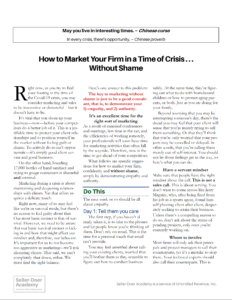
To read specific suggestions for how to market your firm, confidently and without shame, click here for the PDF.

Then click here to send me an email and tell me what you thought of it.

Be well and be safe. Jim

Report cover How to Market Your Firm During Coronavirus Crisis without Shame

Marketing Professional Services Without Shame During a Crisis (by Jim Rogers) revised

Filed Under: Accounting, Business Development, Communication, Construction, Generate Leads, Keep Clients, Professional Services Marketing, Sales, Seller-Doer

Copyright © 2026 by Impellor Group, Inc. · (877) 358-8413