Impellor Group

Turning Expertise into Growth

Call 877.358.8413


  • Welcome
  • For Accounting Firms
    • Client Advisory Capability Lab
    • Constructive Client Conversations
    • Proposal Mastery
    • Rainmaker Mentor
    • Speaking
  • About
  • Contact
  • Insights

Civil Engineering Firms Have Plenty of Work. The Real Strain Is Who’s Ready to Lead Clients Next.

January 13, 2026 by Jim Rogers

Work is plentiful. Client-ready leaders are not.

Across the civil engineering industry, work is not the problem.

Backlogs remain strong. Public and private clients continue to invest in construction. Most firms are busy, and many are stretched.

At the same time, another force is accelerating.

Partners and principals are retiring faster than they can be replaced.

That combination is creating a strain that does not show up in utilization reports — it shows up in how few people are truly ready to lead clients.

The Clock Is Moving Faster Than Firms Admit

Many civil engineering firms were built on a deep bench of long-tenured principals.

That bench is thinning.

Retirements that once felt gradual are now happening in clusters. Institutional knowledge is walking out the door. Client relationships that took decades to build are suddenly exposed.

The uncomfortable truth is this: In many firms, there are fewer successors than successors-in-title.

The Pressure Has Shifted Upward—and Stayed There

As the bench thins, pressure concentrates.

Principals are still selling. Still managing key client relationships. Still stepping in when projects drift off course. Still resolving scope and fee issues late in the game.

They are doing this not because they want to, but because they don’t yet trust enough people to do it without backup.

As firms flatten, more responsibility flows upward. When something feels risky, it lands on a principal’s desk.

This is not a lack of effort — it is a lack of client-ready leverage.

What the Industry Data Shows

Industry reporting from ENR and Deltek reinforces this pattern.

While civil engineering backlogs remain strong, firms continue to cite experience depth and project leadership capacity as major operational risks. The data points in a consistent direction: firms are not struggling to find projects.

They are struggling to field enough professionals who are prepared to lead clients, manage scope, and exercise judgment independently.

As senior leaders retire, that gap becomes more visible—and more dangerous.

Where Profit Quietly Erodes

Margins rarely disappear because of technical mistakes — they erode earlier.

  • They erode when scope is unclear.
  • When expectations go unspoken.
  • When client signals are missed.
  • When uncomfortable conversations are delayed.

When senior leaders step in late to rescue a situation, the firm absorbs the cost. The project may recover. The relationship may be saved. The write-off still happens.

This pattern repeats quietly, especially during leadership transitions.

The Client-Readiness Gap in the Next Generation

Most firms have no shortage of smart engineers.

What they lack is enough people who are ready to lead clients at the executive level.

  • Ready to run meetings without backup.
  • Ready to ask difficult questions early.
  • Ready to explain value, not just deliver projects.
  • Ready to represent the firm when the conversation gets uncomfortable.

These are not innate traits. They are learned capabilities.

When they are concentrated at the top—and the top is retiring—the firm becomes exposed.

Why Traditional Training Isn’t Closing the Gap

Many owners sense this problem and respond with training.

Workshops. Seminars. Speaker series. Online courses.

These efforts are well intentioned — they are rarely sufficient.

Training transfers knowledge; it does not reliably install behavior.

Client leadership requires practice, judgment, and repetition in real situations. Most professionals never get that deliberately. They are expected to “pick it up over time.”

That informal approach worked when timelines were long and benches were deep.

It no longer does.

Capability Building Is the Owner-Level Solution

The firms navigating this transition best are doing something different.

  • They are treating client-facing capability as infrastructure.
  • They identify the specific conversations where risk and value are created.
  • They teach simple, shared frameworks for handling them.
  • They let people practice before the stakes are high.
  • They reinforce those behaviors inside real projects.

The goal is not to turn engineers into salespeople. The goal is to make client leadership repeatable—and transferable—before senior leaders exit.

As capability spreads, reliance on a few individuals declines.

That is how leverage is rebuilt.

What the Strongest Firms Will Look Like

The strongest civil engineering firms will not just be busy. They will be resilient through transition.

  • Clients will trust more than one or two names.
  • Projects will rely less on rescue.
  • Succession will feel earned, not rushed.
  • Retirements will be planned, not feared.

These firms will feel calmer, even as leadership changes.

Not because the work is easier, but because preparedness is deeper.

A Structural Choice for Owners

Civil engineering is not in crisis.

But ownership transitions are accelerating, and the old development model is under strain.

Firms that invest now in building client-ready capability will adapt.

Firms that rely on informal learning and heroic principals will struggle as retirements accelerate.

Only one of those paths protects value.

And only one scales beyond the current generation.

To learn more about how to build client-facing capabilities that stick, call (877) 358-8413 or email info@sellerdoeracademy.com


Filed Under: Business Development, Communication, Engineering, Leadership, Seller-Doer, Uncategorized Tagged With: A/E/C Industry, Civil Engineering, Client Relationships, Engineering Firms, Firm Leverage, Leadership Development, Professional Services Firms, seller-doer, Succession Planning

14 Essential Skills to Thrive as a Successful Seller-Doer

December 18, 2024 by Jim Rogers

In today’s competitive business landscape, the seller-doer role is becoming increasingly vital in professional services. As a professional in your field, whether accounting, architecture, engineering, consulting, or law, your ability to seamlessly integrate business development with project execution can set you apart from your peers. However, excelling in this dual role requires a diverse set of skills.

In this blog, I will share 14 essential skills that will equip you with the tools and insights needed to thrive as a successful seller-doer. Whether you’re just starting or looking to enhance your capabilities, these skills are the building blocks for your career success.

Skill #1: Relationship Building. 

While conducting research for my book, Becoming a Seller-Doer: Succeed at Business Development and Take Command of Your Career, I surveyed over 1,200 A/E/C professionals across various industries. Relationship building topped both our surveys (one quantitative and the other qualitative) as the most important skill for seller-doer success. 

With that being said, take the time to build rapport with your clients through verbal and nonverbal communication, active listening, social awareness, and etiquette.

Skill #2: Public Speaking. 

The fastest and most effective way to become a better speaker is to do it. A successful seller-doer understands how to deliver a range of effective talks, such as project presentations, technical education sessions, and webinars. Toastmasters is an organization devoted to developing public speaking and leadership skills.

Skill #3: Business Writing.

Our definition of business writing skill is “The ability, in a corporate setting, to write clearly to inform or persuade.” To achieve success as a seller-doer, you don’t have to become a stellar writer—it will suffice to write clearly and concisely. Currently, Grammarly is the best tool for improving your writing. It even explains it’s recommendations. If you’re using AI to help you write, beware: most generative AI tools are subpar at grammar, which creates clarity.

Skill #4: Storytelling.

Tell stories that engage and influence the listener. Storytelling is essential in marketing and business development. Can you tell your story and your firm’s at a networking event, during a business development call, or in a project meeting? These are all places where selling “happens.”

Skill #5: Market & Client Research.

Acquire Industry Knowledge: Stay updated on the latest trends, innovations, and challenges within your industry. 

Gather Client Intelligence: Gain deep insights into your clients’ businesses, needs, and pain points. This includes understanding their goals, strategies, and decision-making processes. 

Gain Competitor Understanding: Analyze your competitors to identify their strengths and weaknesses. This knowledge allows you to differentiate your services and highlight your unique value propositions.

Skill #6: Capture Planning.

Create a plan for acquiring client business. The key is to follow a process of inquiry that will help you decide whether to spend time and treasure in pursuit of a particular contract. When pursuing major accounts, an account pursuit plan is invaluable. If you want templates for capture plans, send me an email: jim@sellerdoeracademy.com

Skill #7: Making Go/No-Go Decisions.

Distinguish worthwhile client pursuits from poor ones. Experienced managers will be expected to have the business acumen and self-awareness to use their understanding of the client, the industry, and the competitive landscape.

Skill #8: Internet Marketing & Networking.

Merriam-Webster defines networking as “the cultivation of productive relationships for employment or business.” This definition works nicely because it is situation-independent and ignores the activity’s medium. You can develop productive relationships at business association meetings while “working the room,” but you can also build relationships by being active on LinkedIn. Use the internet to increase your visibility, build authority, and engage with prospects and clients.

Skill #9: Prospecting.

Find, qualify, and pursue leads for new clients. Think of prospecting this way: It’s your effort to generate leads for new clients through networking, referrals, and proactive phone calls.

Skill #10: Questioning.

Questioning is the process of discovering client needs and wants. Ask effective questions that uncover client needs and preferences. Don’t think of it as selling; think of it as discovery. The art and science of questioning also help a client feel heard and valued.

Skill #11: Positioning.

The act of positioning is to stake out territory in the client’s mind about your attributes and strengths and how they will benefit by working with you. Communicate your firm’s capabilities, markets served, accomplishments, and value proposition.

Skill #12: Proposal Writing.

While all business writing demands writing with clarity, proposal writing is sales writing. It is about convincing decision-makers that you are the best fit for a particular project. Write proposals and letters that close business.

Skill #13: Interview Presentations.

Mastering interview presentations is crucial for winning over clients during short-list interviews. Customize your presentation to address the client’s specific needs and concerns. Clearly articulate your value proposition and highlight the benefits and outcomes the client can expect from working with you. Present your ideas confidently and clearly. Use compelling storytelling techniques to connect with your audience and make your message memorable.

Skill #14: Negotiation.

When closing contracts with clients, much of that responsibility will fall on the principal, who must put their imprimatur on the contract; however, they will rely on the other senior project members to help. Agree on mutually beneficial terms to be formalized in a contract.

Mastering these 14 essential skills will not only equip you to thrive as a seller-doer but will also position you as a key player in your firm’s business development efforts. The ability to build relationships, communicate effectively, and strategically navigate the business landscape is what sets successful seller-doers apart. 

By focusing on these skills, you can take command of your career and make a significant impact on your firm’s growth and success. Embrace the journey of continuous learning and skill development, and watch your career soar to new heights.

Interested in learning more about becoming a successful seller-doer?

Purchase my book on Amazon!

Filed Under: Business Development, Communication, Engineering, Generate Leads, Keep Clients, Networking

Understanding the Client Life Cycle from THEIR Viewpoint

September 26, 2024 by Jim Rogers

Understanding the nuances of client relationships is crucial for business development. In training programs at the Seller-Doer Academy, a recurring theme is: It’s not about you (the consultant); it’s about them (the client). Participants learn to recite the mantra, “It’s not about me; it’s about you.” 

When we think about seller-doer activities, we use the terms marketing, business development, and perhaps even (gasp!) sales. Those terms reflect our perspective of what we need to do to gain clients. However, it is useful to consider the client lifecycle from their perspective of what they need- a demand-side view rather than a supply-side view. 

Let’s explore the five stages of the client life cycle from the demand side and how to strategically align your activities with each stage to maximize your business development success.

Stage #1: Awareness

At this stage, potential clients are just learning about your firm. Your goal is to increase visibility and establish your presence in the industry. Activities include networking, social media engagement, and thought leadership. You establish thought leadership by writing articles or blogs and delivering presentations at conferences or private lunch-and-learns. 

Stage #2: Interest

Once you have a potential client’s attention, the focus shifts to sparking their interest in your services. Share case studies, success stories, and insights that showcase your expertise and how you can solve their problems. When they see that you have helped other firms like theirs, they will comprehend that you can help them, too. 

Stage #3: Consideration

At this stage, potential clients evaluate whether to work with your firm. Perhaps they invite you to talk to them in detail about a particular project or ask you for a proposal so they can weigh you against their other options. 

Stage #4: Selection

Congratulations! They’ve selected you to help them achieve their project goals. 

Stage #5: Commitment

Once working with a client, it’s your job to keep them. Deliver exceptional results, maintain regular communication, and seek feedback to ensure satisfaction and continuous improvement. Commit to the care and nurturing of the people within the organization because organizations don’t make decisions; people in organizations make decisions.

Understanding the client’s lifecycle from the client’s perspective and what you need to do to satisfy their needs at each stage helps direct your activities to build and sustain the relationship.

Interested in learning more about becoming a successful seller-doer?

Click here to purchase my book on Amazon!

Filed Under: Architecture, Business Development, Communication, Engineering, Generate Leads, Keep Clients, Sales

Four Ways Effective Listening Helps With Business Development in Professional Services

April 17, 2023 by Jim Rogers


Effective listening skills 

Effective listening skills are crucial for any consultant looking to provide exceptional service and build a successful practice. When consultants actively listen to their clients, they can better understand their needs and tailor their services to meet those needs. This blog post will explore how effective listening skills help with consultative selling.

1. Build Rapport

Building rapport with the client is the first step in any successful consulting engagement. When a consultant actively listens to their client, they can build rapport by showing genuine interest in what the client says. Active listening includes asking open-ended questions and following up on the client’s responses. By doing so, the consultant can build a relationship with the client, increasing their chances of being hired for future projects.

2. Identify Needs

One of the most critical components of effective listening is identifying the client’s needs. When a consultant listens actively, they can pick up on the client’s pain points and offer solutions to those problems. Understanding the client’s needs can help the consultant position their services as the solution. This can lead to a more targeted consulting engagement and a higher chance of delivering value to the client.

3. Overcome Objections

Every consulting engagement will have complaints from the client, and effective listening skills can help overcome those objections. When a consultant actively listens to the client’s complaints, they can address them directly and offer solutions to alleviate any client’s concerns. The consultant can build trust with the client and increase their chances of delivering successful outcomes.

4. Improve Client Experience

Active listening doesn’t stop after the consulting engagement is completed. When consultants listen to their clients, they can gather feedback and use it to improve their services. Client feedback can also help consultants identify new opportunities for delivering value. By actively listening to their clients, consultants can create a better overall experience and increase client loyalty.

In conclusion, effective listening skills are crucial for any consultant looking to provide exceptional service and build a successful practice. By actively listening to clients, consultants can build rapport, identify needs, overcome objections, and improve the client experience. If you’re a consultant looking to strengthen your skills, focusing on active listening is an excellent place to start.

Filed Under: Business Development, Communication, Engineering, Networking, Professional Services Marketing, Sales, Seller-Doer

Want to Ace your Virtual Short-List Interview? Follow These Tips to Keep the Focus on You and Your Message Instead of on the Technology.

February 10, 2021 by Jim Rogers

One year into the pandemic, MS-Teams and Zoom meetings have become the new normal for most of us. What’s more, your clients are now routinely conducting most, if not all, short-list interview presentations remotely.

More so than an in-person interview presentation, video conferencing inherently has many variables that could distract your audience, undermine your confidence, and ultimately compromise your team’s chances for the award. The variables are compounded by the number of presenters you have and how many virtual sites are involved. If you have six presenters presenting from separate locations, that’s 6x more chances something could go wrong. 

With proper preparation, you can reduce the chances for such distracting problems and you can deliver a more polished and professional presentation that outclasses your competitors. If you and your team members are equally polished, then your professionalism will be all the more impressive.   

In this post, you will learn techniques to make sure your technology comes off without a hitch and creates a more professional perception of you with your client. While you should check in with your “IT guy,” here are some DIY steps you can take, regardless of how much tech support you get.  

Technology/Bandwidth at Home

Your office is a safe, fast, reliable place to be for an interview. That said, most of my clients have been in their home offices because of the recent surge. Home is not usually as reliable. 

At home, be sure to head off any connectivity issues. First, if you can, connect your computer to your router through an ethernet cable instead of Wi-Fi. Your ethernet cable will be more reliable. If your computer is within sight of the router, you may find that your 5G frequency will perform better than 2G. However, if your router is in another room, you may find 2G to be more reliable. 

Reboot

If you haven’t rebooted your equipment in a while, take the time to restart your laptop, cable modem and router. Your internet service provider should have instructions on the sequence you should use. Play it safe by doing it the day before, not hours or minutes before showtime — you don’t want to get frantic the day of the presentation if you encounter an issue that takes some time to resolve. 

Pause Sync

Contention for bandwidth can yield poor audio and video quality. To ensure that your video conference software isn’t competing for bandwidth, pause any backup synchronization software such as Dropbox, OneDrive, iDrive, or Google Drive. This is especially important if you do not have blazing fast internet. Then, make sure you’re not competing with other members of your household. If it can be helped (hey, lots of us have kids at home doing remote instruction), take care that they’re not downloading or streaming movies or music — or gaming! 

Checklist for go time

  • Ask household members not to stream music and movies or play games online during the call
  • Close any applications not needed for the presentation
  • Pause any backup services
  • Fully charge your headset 
  • Fully charge your laptop, or better yet, plug it in.  

Sound

The key here is that your voice should be heard clearly — and it should be the only thing heard. Make sure you are close enough to your microphone. Check for ambient noise in the room, for example, a fan. If you are using two computers, make sure that you only have one microphone open and that you only have one speaker active. 

Checklist for go time

  • Place a do not disturb sign on your door
  • Turn off the cell phone ringer
  • Mute email alerts on your computer 
  • Mute Alexa or Siri, or whoever your personal assistant may be
  • Mute yourself when not speaking, so the client can hear your teammate. 

Video

Even though their cameras may be off, your client wants to see your face — and your expressions: camera positioning and lighting drive that. Try to avoid having a window behind you and be sure to have a light in front of you. A selfie ring light is a good choice, but a desk lamp will do. I have a $20 desk lamp in front of me with a low wattage bulb, pointed a bit downward so I’m not blinded by it. 

Proportion matters: Don’t center your face on the screen; this leaves a big open space above the top of your head, which is distracting. Vertically, your screen should show from armpit to top of cowboy hat (that’s 3 fingers above-head if you don’t have a cowboy hat!) with your eyes at 2/3 of the way up. Laterally, your face takes up the middle 30% of the screen. Put your laptop on a box or stack of books, if necessary.  

Get a Quality Camera

Make sure you are happy with the quality of your camera and microphone. Many laptop cameras are grainy and hate low lighting. 

For a high stakes presentation, consider an upgrade to an external HD camera with a better lens and more features, like adjustments for low lighting. I have a Logitech C920 for under $100 that has worked great for hundreds of webinars and video calls over the years. [Note: Many firms have been buying and shipping equipment upgrades directly to interview teams or are reimbursing them after the fact, because they know what is on the line … and it’s a small price to pay.]

A word about virtual backgrounds … because it is friendlier, I recommend using your office (wherever that may be) as a natural work setting if you are able to stage it nicely. Make sure the scenery behind you is professional and reflects your work personality. As I live in Kentucky, I have a bottle of bourbon (unopened, mind you) on the table behind me for a conversation piece. If I had a high-stakes presentation with a client that didn’t know me well, I would consider stowing it out of sight. 

Alternatively, a meaningful virtual background would be one that reflects work that you have done or are doing, such as a clear photograph of a client project you’re proud of. Such green screen-type, virtual backdrops are tricky, though — when you move, you break up around the edges of your head and body outline. Parts of you can disappear as you are talking if you’re an animated presenter. 

Checklist for go time

  • Point camera at eye level
  • Wipe camera lens clean 
  • Check the background for distracting items
  • Make sure you are front-lit, not backlit
  • Position yourself close enough to adjust the camera if needed
  • Turn off the camera when not speaking, so you can feature the speaker (but follow whatever rules your presentation team has agreed on)

Finally

Remember, your work does not speak for itself — your video presentation speaks for it. If your work is worth a client’s attention, aim to deliver it flawlessly. To keep your work from being obscured by any distractions, there is a lot to attend to. 

Adopt the mindset of an athlete — respect the importance of pregame preparation by attending to these many variables. And when you’re done, win or lose, you’ll be satisfied knowing that you left it all on the playing field. 


Filed Under: Architecture, Business Development, Communication, Construction, Engineering, Interview Presentations, Presentation, Professional Services Marketing, Proposal Writing, Seller-Doer, Short List Interview Presentations

Want to See Better Business Development Success in 30 Days? Then Become a Better Listener

February 2, 2021 by Jim Rogers

Business development is about building relationships. Listening builds relationships.

If you’re trying to develop new clients, then listening well is your surest way to build rapport. In mere minutes, it can generate lasting positive feelings that accelerate the relationship-building process. In fact, you will earn their trust quicker, which typically takes a while with new relationships.

When it comes to existing clients, listening more effectively will not only position you better for immediate and long-term opportunities, but it can also lead to the sort of bond that only trusted advisors have with their clients. And those clients can end up sticking with you not just for years, but for decades.

So, ask yourself: Are you a good listener? A good listener:

  • is in the here and now, avoiding distraction
  • avoids rushing to judgment
  • is curious and asks the right questions
  • does not interrupt, and
  • makes others feel heard.

Developing a Listening Mindset: Empathy is the Key

Your first key to listening is to set aside your own needs for a few minutes and genuinely seek to understand what the other is trying to convey. This is about mindset. If you go into the conversation thinking about “selling,” then you’re more likely to be waiting for your turn to jump in and be interesting, solve a problem, or prove how smart you are. The “selling” mindset is the saboteur of listening. Business development is built on relationships and listening builds relationships. So listen first, sell second.

If you want to be a better listener, you need to know how good listeners do it. Effective listening is a skill that has three parts: attentive listening, active listening, and most importantly, empathic listening.

First, attentive listening.

Attentiveness is physically showing that you’re listening and are paying attention. We show attentiveness with non-verbal cues such as steady eye contact, head nodding, the occasional uh-huh or hmm, or even through a knowing smile. At a networking event, you aren’t looking over their shoulder to see who else might be in the room. And you’re not looking at your phone for tapas recipes on Pinterest.

Second, active listening.

Active listening makes people feel heard. It means being involved in the conversation by paraphrasing what the speaker has said and asking effective follow up questions. Rather than mimicking or parroting what they said almost verbatim, it’s better to just use your own words to confirm that you have heard them correctly.

Good stock questions that make people feel listened to are:

  • What do you mean?
  • Why do you say that?
  • What happened next?
  • Can you give me an example?

Finally, empathic listening.

If you want to truly connect with people, empathic listening is the best method. It means playing back the emotion you hear behind what the other person said. An empathic response shows that you hear the emotion behind the words. An active question may make someone feel listened to, but an empathic listener makes someone feel understood.

Empathic listening requires a thoughtful response. If a client’s response to your simple query of “How’s it going?” is a sarcastic, “I’m living the dream, staring at spreadsheets all day again,” an empathic listening response would be: “You’d rather be doing something else.” Or “Sounds like that’s not the most exciting part of your job.”

Empathy Is not Easy but Blocking It Is

For most of us, the empathic response is not our stock response, and it takes some work to learn. In fact, some of our stock responses to the people around us who need empathy result in exactly the opposite: we further alienate them. We fall back on these “empathy blockers” when we seek to distract from a trying situation and force someone to move on from it, whether or not they’re ready to.

If you find yourself having cliché, knee-jerk reactions to the complaints of those around you, you may be blocking empathy. If your response to the above client is a throwaway line like “Yeah, I spend way too much time in front of Excel too,” or “Maybe you should hire an assistant,” or “At least you have a job,” you are not helping them. You are blocking empathy — and the possibility of a deeper connection.

How to Practice and Improve

Ceasing to block empathy is a positive step, however, to build empathic listening skills takes practice and you master it gradually. Start small: instead of using every communication interaction you have with every human you interact with, to get practicing, pick one person from your work life and one from your home life.

By having one person in each environment in mind to practice empathic listening, each time you encounter them will be a trigger for you to stop, listen attentively, and really try to get at their emotion. Try this for a week and when you’re comfortable, pick one more person to focus on for the next week.

Generally, it takes about a month to develop a new habit — if you work at it. In the case of listening, you will quickly notice people responding to you differently, and the value added to your business relationships will last your entire career. And it will show up as new opportunities in the pipeline and more revenue on the books.

Want to Get Better at Listening?

There are many good resources for improving listening skills.

Web Articles

If you are on ToolsHero, go to https://www.toolshero.com/communication-skills/empathic-listening/

Harvard Business Review has a nice summary:

https://hbr.org/2016/07/what-great-listeners-actually-do

Moving from Active Listening to Empathic Listening:

https://www.mindtools.com/CommSkll/EmpathicListening.htm

Web Videos

Communication Coach Alex Lyon has a great session on it:

https://www.youtube.com/watch?v=lO1gpzakbik

Therapy in a Nutshell has a good video with strong examples for your personal life:

https://www.youtube.com/watch?v=MGdgUP8XLwc

Print Books on Listening

  • The Lost Art of Listening: How Learning to Listen Can Improve Relationships (Michael P. Nichols)
  • The Seven Habits of Highly Effective People: Powerful Lessons in Personal Change (Chapter 7: Seek First to Understand)
  • Working with Emotional Intelligence (Daniel Goleman)


Filed Under: Architecture, Business Development, Communication, Construction, Engineering, Generate Leads, Professional Services Marketing, Seller-Doer

Public Speaking Is Essential for Seller-Doers: Here’s How to Get Better Right Away

January 28, 2021 by Jim Rogers

Warren Buffet, one of the world’s wealthiest men, asserts that public speaking is the single greatest skill to boost your career. Even if you’re not a business tycoon, the advice still rings true: improving public speaking skills is one of the most fundamental ways seller-doers can hone their business development skills.

I define a seller-doer as “a billable professional who takes purposeful action to help generate revenue for their firm.” In professional services, purposeful action may be speaking at conferences, taking part in interview presentations, and conducting lunch and learns.

Competency as a speaker can also help make you more effective when presenting at project or public meetings or even at a professional association chapter meeting.

What Level of Speaker Are You and Where Do You Need to Be?

The public speaking skills you need to develop will depend on your current capability. It will also depend on what speaking opportunities will help you best serve today’s clients and attract tomorrow’s.

  • Novice speakers are still nervous about speaking to groups. Novice public speakers should aim to overcome their fear of public speaking and learn the fundamentals — keeping their focus while picking up on audience engagement. Novice speakers are generally comfortable with small groups; a good place for them to practice might be an internal meeting where the faces are familiar and the stakes are low.
  • Intermediate speakers are comfortable with an audience and are consistently effective. Intermediate speakers should aim to be more agile when communicating complex ideas, and to pivot to a new topic if something isn’t working. These speakers are more comfortable with larger audiences; they might be good candidates to host lunch and learns or technical training.
  • Advanced speakers project confidence and can speak with little preparation on topics they know well. Most AEC roles don’t require expert-level presenters, but advanced speakers looking to step up their game should focus on making their presentations more engaging. These speakers are often the best key presenters for interview presentations.

So where do you fit in and where do you need to land? If you’re going to have a substantive role in short-list interview presentations or be an industry thought leader presenting at several conferences a year, you may aim to become an advanced speaker.

If you’ll primarily be presenting at public meetings, conducting lunch and learns, and occasionally presenting on technical topics at conferences, then intermediate may be a good enough landing point for you. Regardless of where you’re headed, if you’re a novice, it’s time to get started – with purpose – to improve.

Skill-Building Strategies

The best way to become a better speaker is to practice. Books about public speaking are ineffective teachers since they can’t give you the depth of wisdom you’ll gain through experience. Once you’ve learned a few tips, the fastest and most effective way to become a better speaker is to just do it.

With that in mind, our strategies to build your skill and comfort with public speaking are:

  1. Join Toastmasters
  2. Fail Small
  3. Volunteer
  4. Persist!

Join Toastmasters

Toastmasters is a nonprofit organization that helps people become more confident speakers—and with more than 16,600 clubs in 143 countries, it’s likely that there’s a chapter near you. Because the organization is 100 years old, it has carefully crafted and road tested a process for helping people succeed at speaking.

Although many people join Toastmasters to overcome their fear of speaking, others join to become better leaders, more competent speakers, or even to join the ranks of professional speakers.

For a low semi-annual fee, you’ll be able to meet weekly or bi-weekly to practice your speaking skills and do some self-study and speech preparation in your outside time. The structure of the program ensures that people get a chance to practice not only speeches, but also writing, impromptu speaking, storytelling, and more!

You can also get involved in committees and leadership roles to develop marketing, interpersonal, and leadership skills. Whatever role you decide on, Toastmasters’ members are always genuinely nice and deliver feedback in a kind, constructive manner. As a bonus, many it’s fun! It’s easiest to learn in a safe, fun environment, and Toastmasters delivers on this, for speakers of all skill levels.

Fail Small

Seek out low-risk opportunities to speak, whether you’re trying to overcome your fear of speaking or develop from a more solid foundation. The types of preparation that will help you exude confidence are the small, everyday ways you can practice speaking, whether you’re asking a question in a large meeting or hosting a brown bag lunch.

Small steps mean practicing the basics; for example, learning how to speak succinctly instead of rambling. In general, it’s good to aim for thoughtful contributions that make people glad you stood up to speak.

If you’re a bit rusty at public speaking, you’ll inevitably make mistakes, but from those failures will come important growth that will help you succeed when it really matters. You’ll thank yourself later when you’re facing a more high-stakes situation, like an interview presentation for an important client.

Volunteer

Volunteering in leadership roles is a win-win: the community benefits from your service, and you benefit from the opportunities to practice public speaking. Community service and volunteer leadership roles give you valuable training, as they often involve a public speaking component. When you’re called on to use your public speaking skills, you’ll receive informal training that will hone them through experience alone. No matter what your current skill level is, you’ll improve with practice.

Volunteer roles can take many forms, including coaching youth sports, taking part on the board of a nonprofit, or presenting in a public meeting. Whatever organization you volunteer for, make it something you are passionate about.

Persist!

If you tend to look up to principals in your firm who speak with confidence and think, “I could never do what they do,” you might be surprised at how people got where they are today. Many advanced speakers started out as nervous, novice speakers. Practice is the key to improving your public speaking skills—never turn down a chance to speak.

Recommendations for Further Reading:

If you’re a new speaker trying to overcome your fear of public speaking, this HBR article outlines a unique way to use kindness to your advantage: https://hbr.org/2019/09/to-overcome-your-fear-of-public-speaking-stop-thinking-about-yourself

Looking for a few quick tips? inc.com has a list of 20 general tips that help you prepare for a presentation: https://www.inc.com/brent-gleeson/20-tips-for-mastering-art-of-public-speaking.html

For some guidance on a specific type of speaking engagement, Toastmasters has public speaking tips for awards, sales pitches, technical briefings, and more: https://www.toastmasters.org/resources/public-speaking-tips

Finally, listen to some speakers in action with this TED Talks “Before public speaking…” playlist: https://www.ted.com/playlists/226/before_public_speaking


Filed Under: Accounting, Architecture, Business Development, Communication, Construction, Engineering, Interview Presentations, Management Consulting, Presentation, Professional Services Marketing, Sales, Seller-Doer

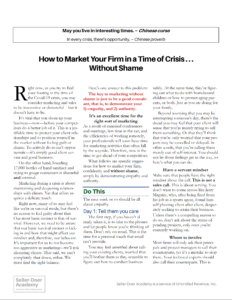
How to Market Your Firm During the Coronavirus Crisis . . . Without Shame

March 22, 2020 by Jim Rogers

Hundred Dollar Bill with Benjamin Franklin in Coronavirus Protective Mask

Right now, as you try to find your footing in the time of the Covid19 pandemic, you may consider marketing and sales to be insensitive or distasteful—but it doesn’t have to be.

It’s vital that you shore up your business—now—before your competitors do a better job of it. This is a justifiable time to protect your client relationships and to position yourself in the market without feeling guilt or shame. To actively do so isn’t opportunistic—it’s simply good client service and good business.

On the other hand, hoarding 17,000 bottles of hand sanitizer and trying to gouge consumers is shameful and criminal.

Marketing during a crisis is about maintaining and deepening relationships with clients. Yet that effort requires a delicate touch.

The key to delicate touch is just to:

  1. Show that you care
  2. Share knowledge that helps clients work better, faster, and cheaper during the crisis.

To read specific suggestions for how to market your firm, confidently and without shame, click here for the PDF.

Then click here to send me an email and tell me what you thought of it.

Be well and be safe. Jim

Report cover How to Market Your Firm During Coronavirus Crisis without Shame

Marketing Professional Services Without Shame During a Crisis (by Jim Rogers) revised

Filed Under: Accounting, Business Development, Communication, Construction, Generate Leads, Keep Clients, Professional Services Marketing, Sales, Seller-Doer

Copyright © 2026 by Impellor Group, Inc. · (877) 358-8413