Impellor Group

Turning Expertise into Growth

Call 877.358.8413


  • Welcome
  • For Accounting Firms
    • Client Advisory Capability Lab
    • Constructive Client Conversations
    • Proposal Mastery
    • Rainmaker Mentor
    • Speaking
  • About
  • Contact
  • Insights
You are here: Home / Blog

Want to See Better Business Development Success in 30 Days? Then Become a Better Listener

February 2, 2021 by Jim Rogers

Business development is about building relationships. Listening builds relationships.

If you’re trying to develop new clients, then listening well is your surest way to build rapport. In mere minutes, it can generate lasting positive feelings that accelerate the relationship-building process. In fact, you will earn their trust quicker, which typically takes a while with new relationships.

When it comes to existing clients, listening more effectively will not only position you better for immediate and long-term opportunities, but it can also lead to the sort of bond that only trusted advisors have with their clients. And those clients can end up sticking with you not just for years, but for decades.

So, ask yourself: Are you a good listener? A good listener:

  • is in the here and now, avoiding distraction
  • avoids rushing to judgment
  • is curious and asks the right questions
  • does not interrupt, and
  • makes others feel heard.

Developing a Listening Mindset: Empathy is the Key

Your first key to listening is to set aside your own needs for a few minutes and genuinely seek to understand what the other is trying to convey. This is about mindset. If you go into the conversation thinking about “selling,” then you’re more likely to be waiting for your turn to jump in and be interesting, solve a problem, or prove how smart you are. The “selling” mindset is the saboteur of listening. Business development is built on relationships and listening builds relationships. So listen first, sell second.

If you want to be a better listener, you need to know how good listeners do it. Effective listening is a skill that has three parts: attentive listening, active listening, and most importantly, empathic listening.

First, attentive listening.

Attentiveness is physically showing that you’re listening and are paying attention. We show attentiveness with non-verbal cues such as steady eye contact, head nodding, the occasional uh-huh or hmm, or even through a knowing smile. At a networking event, you aren’t looking over their shoulder to see who else might be in the room. And you’re not looking at your phone for tapas recipes on Pinterest.

Second, active listening.

Active listening makes people feel heard. It means being involved in the conversation by paraphrasing what the speaker has said and asking effective follow up questions. Rather than mimicking or parroting what they said almost verbatim, it’s better to just use your own words to confirm that you have heard them correctly.

Good stock questions that make people feel listened to are:

  • What do you mean?
  • Why do you say that?
  • What happened next?
  • Can you give me an example?

Finally, empathic listening.

If you want to truly connect with people, empathic listening is the best method. It means playing back the emotion you hear behind what the other person said. An empathic response shows that you hear the emotion behind the words. An active question may make someone feel listened to, but an empathic listener makes someone feel understood.

Empathic listening requires a thoughtful response. If a client’s response to your simple query of “How’s it going?” is a sarcastic, “I’m living the dream, staring at spreadsheets all day again,” an empathic listening response would be: “You’d rather be doing something else.” Or “Sounds like that’s not the most exciting part of your job.”

Empathy Is not Easy but Blocking It Is

For most of us, the empathic response is not our stock response, and it takes some work to learn. In fact, some of our stock responses to the people around us who need empathy result in exactly the opposite: we further alienate them. We fall back on these “empathy blockers” when we seek to distract from a trying situation and force someone to move on from it, whether or not they’re ready to.

If you find yourself having cliché, knee-jerk reactions to the complaints of those around you, you may be blocking empathy. If your response to the above client is a throwaway line like “Yeah, I spend way too much time in front of Excel too,” or “Maybe you should hire an assistant,” or “At least you have a job,” you are not helping them. You are blocking empathy — and the possibility of a deeper connection.

How to Practice and Improve

Ceasing to block empathy is a positive step, however, to build empathic listening skills takes practice and you master it gradually. Start small: instead of using every communication interaction you have with every human you interact with, to get practicing, pick one person from your work life and one from your home life.

By having one person in each environment in mind to practice empathic listening, each time you encounter them will be a trigger for you to stop, listen attentively, and really try to get at their emotion. Try this for a week and when you’re comfortable, pick one more person to focus on for the next week.

Generally, it takes about a month to develop a new habit — if you work at it. In the case of listening, you will quickly notice people responding to you differently, and the value added to your business relationships will last your entire career. And it will show up as new opportunities in the pipeline and more revenue on the books.

Want to Get Better at Listening?

There are many good resources for improving listening skills.

Web Articles

If you are on ToolsHero, go to https://www.toolshero.com/communication-skills/empathic-listening/

Harvard Business Review has a nice summary:

https://hbr.org/2016/07/what-great-listeners-actually-do

Moving from Active Listening to Empathic Listening:

https://www.mindtools.com/CommSkll/EmpathicListening.htm

Web Videos

Communication Coach Alex Lyon has a great session on it:

https://www.youtube.com/watch?v=lO1gpzakbik

Therapy in a Nutshell has a good video with strong examples for your personal life:

https://www.youtube.com/watch?v=MGdgUP8XLwc

Print Books on Listening

  • The Lost Art of Listening: How Learning to Listen Can Improve Relationships (Michael P. Nichols)
  • The Seven Habits of Highly Effective People: Powerful Lessons in Personal Change (Chapter 7: Seek First to Understand)
  • Working with Emotional Intelligence (Daniel Goleman)



Filed Under: Architecture, Business Development, Communication, Construction, Engineering, Generate Leads, Professional Services Marketing, Seller-Doer

Public Speaking Is Essential for Seller-Doers: Here’s How to Get Better Right Away

January 28, 2021 by Jim Rogers

Warren Buffet, one of the world’s wealthiest men, asserts that public speaking is the single greatest skill to boost your career. Even if you’re not a business tycoon, the advice still rings true: improving public speaking skills is one of the most fundamental ways seller-doers can hone their business development skills.

I define a seller-doer as “a billable professional who takes purposeful action to help generate revenue for their firm.” In professional services, purposeful action may be speaking at conferences, taking part in interview presentations, and conducting lunch and learns.

Competency as a speaker can also help make you more effective when presenting at project or public meetings or even at a professional association chapter meeting.

What Level of Speaker Are You and Where Do You Need to Be?

The public speaking skills you need to develop will depend on your current capability. It will also depend on what speaking opportunities will help you best serve today’s clients and attract tomorrow’s.

  • Novice speakers are still nervous about speaking to groups. Novice public speakers should aim to overcome their fear of public speaking and learn the fundamentals — keeping their focus while picking up on audience engagement. Novice speakers are generally comfortable with small groups; a good place for them to practice might be an internal meeting where the faces are familiar and the stakes are low.
  • Intermediate speakers are comfortable with an audience and are consistently effective. Intermediate speakers should aim to be more agile when communicating complex ideas, and to pivot to a new topic if something isn’t working. These speakers are more comfortable with larger audiences; they might be good candidates to host lunch and learns or technical training.
  • Advanced speakers project confidence and can speak with little preparation on topics they know well. Most AEC roles don’t require expert-level presenters, but advanced speakers looking to step up their game should focus on making their presentations more engaging. These speakers are often the best key presenters for interview presentations.

So where do you fit in and where do you need to land? If you’re going to have a substantive role in short-list interview presentations or be an industry thought leader presenting at several conferences a year, you may aim to become an advanced speaker.

If you’ll primarily be presenting at public meetings, conducting lunch and learns, and occasionally presenting on technical topics at conferences, then intermediate may be a good enough landing point for you. Regardless of where you’re headed, if you’re a novice, it’s time to get started – with purpose – to improve.

Skill-Building Strategies

The best way to become a better speaker is to practice. Books about public speaking are ineffective teachers since they can’t give you the depth of wisdom you’ll gain through experience. Once you’ve learned a few tips, the fastest and most effective way to become a better speaker is to just do it.

With that in mind, our strategies to build your skill and comfort with public speaking are:

  1. Join Toastmasters
  2. Fail Small
  3. Volunteer
  4. Persist!

Join Toastmasters

Toastmasters is a nonprofit organization that helps people become more confident speakers—and with more than 16,600 clubs in 143 countries, it’s likely that there’s a chapter near you. Because the organization is 100 years old, it has carefully crafted and road tested a process for helping people succeed at speaking.

Although many people join Toastmasters to overcome their fear of speaking, others join to become better leaders, more competent speakers, or even to join the ranks of professional speakers.

For a low semi-annual fee, you’ll be able to meet weekly or bi-weekly to practice your speaking skills and do some self-study and speech preparation in your outside time. The structure of the program ensures that people get a chance to practice not only speeches, but also writing, impromptu speaking, storytelling, and more!

You can also get involved in committees and leadership roles to develop marketing, interpersonal, and leadership skills. Whatever role you decide on, Toastmasters’ members are always genuinely nice and deliver feedback in a kind, constructive manner. As a bonus, many it’s fun! It’s easiest to learn in a safe, fun environment, and Toastmasters delivers on this, for speakers of all skill levels.

Fail Small

Seek out low-risk opportunities to speak, whether you’re trying to overcome your fear of speaking or develop from a more solid foundation. The types of preparation that will help you exude confidence are the small, everyday ways you can practice speaking, whether you’re asking a question in a large meeting or hosting a brown bag lunch.

Small steps mean practicing the basics; for example, learning how to speak succinctly instead of rambling. In general, it’s good to aim for thoughtful contributions that make people glad you stood up to speak.

If you’re a bit rusty at public speaking, you’ll inevitably make mistakes, but from those failures will come important growth that will help you succeed when it really matters. You’ll thank yourself later when you’re facing a more high-stakes situation, like an interview presentation for an important client.

Volunteer

Volunteering in leadership roles is a win-win: the community benefits from your service, and you benefit from the opportunities to practice public speaking. Community service and volunteer leadership roles give you valuable training, as they often involve a public speaking component. When you’re called on to use your public speaking skills, you’ll receive informal training that will hone them through experience alone. No matter what your current skill level is, you’ll improve with practice.

Volunteer roles can take many forms, including coaching youth sports, taking part on the board of a nonprofit, or presenting in a public meeting. Whatever organization you volunteer for, make it something you are passionate about.

Persist!

If you tend to look up to principals in your firm who speak with confidence and think, “I could never do what they do,” you might be surprised at how people got where they are today. Many advanced speakers started out as nervous, novice speakers. Practice is the key to improving your public speaking skills—never turn down a chance to speak.

Recommendations for Further Reading:

If you’re a new speaker trying to overcome your fear of public speaking, this HBR article outlines a unique way to use kindness to your advantage: https://hbr.org/2019/09/to-overcome-your-fear-of-public-speaking-stop-thinking-about-yourself

Looking for a few quick tips? inc.com has a list of 20 general tips that help you prepare for a presentation: https://www.inc.com/brent-gleeson/20-tips-for-mastering-art-of-public-speaking.html

For some guidance on a specific type of speaking engagement, Toastmasters has public speaking tips for awards, sales pitches, technical briefings, and more: https://www.toastmasters.org/resources/public-speaking-tips

Finally, listen to some speakers in action with this TED Talks “Before public speaking…” playlist: https://www.ted.com/playlists/226/before_public_speaking


Filed Under: Accounting, Architecture, Business Development, Communication, Construction, Engineering, Interview Presentations, Management Consulting, Presentation, Professional Services Marketing, Sales, Seller-Doer

The 4 Capabilities Every Seller-Doer Must Develop

October 27, 2020 by Jim Rogers


If you are in professional services and want to work on the most exciting projects for the best clients, maximize your compensation, become indispensable, and take command of your career, then merely delivering excellent client service is not enough. You must do something, anything, to help bring in revenue.

That’s what seller-doers do.

Seller-doer defined

I define a seller-doer as a billable professional who takes purposeful action to help generate revenue for their firm.

The word “doer” implies that you are actively engaged in billable client work as opposed to being a full-time business developer or marketing professional.

“Seller” refers broadly to marketing and business activities that generate revenue for your firm.

I include the word “help” in the definition because your involvement in generating revenue will be based on the nature of your business and where you are in your career. In other words, you don’t have to be a rainmaker, or principal, to be a seller-doer with impact.

Take purposeful action

The middle part of the definition, “takes purposeful action,” simply means that you are doing something other than just delivering top quality deliverables and successful outcomes for client projects.

Below are five examples of activities in which seller-doers might participate.

  1. Raise awareness of your firm by speaking at conferences, blogging, and being active on LinkedIn or Twitter or both.
  2. Grow your network and develop leads for new clients by attending networking events.
  3. Ask an existing client for a referral.
  4. Help identify opportunities for new projects with existing clients… before your competitors do.
  5. Write or contribute to proposals and interview presentations.

What must a seller-doer learn?

To succeed in those activities, there are four capabilities that every seller doer must develop: communication, marketing, business development, and closing the sale. Let’s take them one by one.

Communication

Communication is the foundation of everything a seller-doer does and is the place to start if you don’t have these building blocks in place. If you can’t communicate effectively, tackling the other skills will be difficult if not futile. The skills include the following:

  • People skills
  • Business writing
  • Public speaking, and
  • Persuasion.

Effective communication is the key to establishing healthy working relationships with clients. Similarly, people skills allow you to build rapport and credibility, thereby fostering trust between you and your clients. Being able to write and speak clearly and persuasively will help you convey your best ideas in a compelling way that helps you stand out from the crowd.

Marketing

Marketing is the most important means of attracting new clients. A large part of this for any professional is in growing your network and raising awareness of your firm’s (and your) capabilities. You can do this through writing, speaking, and attending networking events, and being active on LinkedIn.

If you’ve been tasked with finding new clients rather than just developing new work for existing clients, then prospecting is essential. This may require your being able to perform market and client research to identify best clients.

You’ll need to know how to get referrals from existing clients and others in your network. And you’ll need to have the phone skills that can get a prospect to take a first meeting with you. Do an excellent job and you’ll soon be pumping new project leads into the pipeline. And when it comes to revenue generation, the pipeline rules all.

Business Development

Business development is the process for moving project and contract opportunities through the pipeline up to the brink of proposing on and winning the business. It’s in this middle stage of the client lifecycle where most deals are won or lost. Four business development skills that you will need are listed below:

  • Planning a compelling sales call
  • Questioning and listening
  • Positioning (i.e., articulating your value proposition), and
  • Capture planning and making good go/no-go decisions.

Closing the Sale

Closing is the last step in getting work in the door and an important seller-doer capability. For you to operate within this part of the client lifecycle, you need to learn these skills:

  • Proposal writing
  • Interview presentations, and
  • Negotiation.

These skills get the fees on the books. If you’re just starting out, you might volunteer to help by writing similar project descriptions and resumes for a proposal or to help run the dress rehearsal for a high-stakes interview presentation.

Speaking of Volunteering

I asked 30 top AEC executives how they would recommend developing seller-doer skills. Number one? Volunteering.

Volunteer in your professional association, in your client trade associations, and in your community. You’ll not only develop skills, you’ll be growing your network and discovering new clients.

The top four strategies for developing seller-doer skills, as recommended by executives are these:

  1. Volunteering (as described above)
  2. Conducting lunch & learns for existing clients. . . and prospective ones
  3. Joining Toastmasters International (a nonprofit educational organization that teaches public speaking and leadership skills through a worldwide network of clubs), and
  4. Joining or participating in the Society for Marketing Professional Services (SMPS).

Be sure to check back next week for upcoming posts on this subject with more details on how to become an effective seller-doer.

And, if you want to stay apprised of the upcoming book tentatively titled Becoming a Seller-Doer, then click here to sign up for periodic alerts.

Filed Under: Accounting, Architecture, Business Development, Construction, Engineering, Management Consulting, Seller-Doer

The Best Way to Start Your Proposal

June 3, 2020 by Jim Rogers

The strongest way to begin your cover letter or executive summary is by answering the question “Why now?”

Think about this question from your client’s perspective. Why are they undertaking this project now and not later … or never?

In other words, why is this a higher priority than other endeavors on which they could be spending their money and time?

Examples of answers to the question “Why now?” include these:

  • Strengthen the community
  • Streamline processes to save money
  • Improve public safety
  • Get (and stay) in compliance
  • Make work easier
  • Heal people
  • Economic development
  • Create classrooms where kids can learn and grow
  • Make customers happy
  • Win new business
  • Take control of your professional destiny
  • Be a better leader
  • Grow market share
  • Provide affordable housing
  • Create healthy, safe workplaces.

Clients aren’t ready to listen to you talk about yourself until you’ve demonstrated that you understand something about them and their problem.

In other words, that you “get” them.

Answer the question “Why now?” early in your cover letter, executive summary, or approach section (or all three) and you will be on your way to winning more work.

There’s more about this topic in my book Win More Work: How to Write Winning AEC Proposals.

If you have an important proposal, reach out to me at Jim@SellerDoerAcademy.com. We’re here to help in whatever way we can to help you win.

Best,

Jim

Filed Under: Business Development, Interview Presentations, Professional Services Marketing, Proposal Writing, Sales, Seller-Doer

It’s Always a Good Time to Grow Market Share . . . Writing Superior Proposals Can Help

June 1, 2020 by Jim Rogers

Whether your business has been positively or negatively affected by the changing economy, there is still an opportunity to strengthen your firm. That’s because there’s one unalterable truth in business — regardless of whether there’s contraction or expansion in your industry, there’s always an opportunity to grow your market share.

That is, your chance to outsell your competitors never goes away.

In the unfortunate event that your markets shrink, there’s still the chance to take work away from your competitors and emerge in a stronger financial position than they will.

You’ll be able to retain the best talent because they won’t lack for work.

And you’ll cement your relationships with your most profitable clients at the expense of your competitors, which will pay off handsomely down the road.

On the other hand, if you’re fortunate enough to be in an expanding industry, as always, you can grow at a faster rate than your market does as a whole. After all, why be content with your usual share?

So what’s the best way to outsell your competitors?

Right now, uncertainty in some industries means that projects and contracts have been delayed or canceled, therefore it’s important to close on immediate opportunities that have been funded and will proceed. Spend extra time and care on these proposals.

If you’re the front-runner for the project, it’s not the time to assume that the work is yours to lose, but rather it’s time to slam the door shut and remove all doubt that you deserve the work. Ratchet up your proposals a notch.

If you’re neck and neck or within striking distance, it’s time to distinguish your proposals and separate yourself from the pack. Pull out all the stops.

Have Discipline in Your Go/No-Go Process

Be honest about whether you’re in striking distance or if you’re a long shot.

If you’re a long-shot, now may be the time to no-go those opportunities and instead put more care and attention into your higher probability pursuits.

Desperate consultants will pursue everything they’re qualified for in the hopes of hitting the elusive jackpot. Unfortunately, because those rare events do happen from time to time, principals and project managers will point back to them as justification for long-shot pursuits.

I may be wrong, but for your clients in vulnerable industries, unless they perceive you as a lower cost option, your chances of winning a long-shot drops to near zero. Clients in vulnerable sectors will likely consolidate their work around their top go-to consultants. If you’re not in their elite pool, you are probably a long-shot in the short term.

In all cases, your best bet is to write superior, not routine, proposals.

Strategies for Preparing Superior Proposals

In my next series of posts, I’ll share my best tips to help you separate your proposals from those of your competitors, including these:

  1. The most powerful way to begin your proposal
  2. How to put the focus on the client rather than on yourself
  3. Win themes that sell
  4. How to strip your proposals of marketing blather that clutters your best ideas
  5. How to describe your strengths in a way that differentiates you from your competitors
  6. Graphic design choices that make your best ideas shine through
  7. Twenty proposal mistakes that can sink your proposal.

Much of the advice I share is also captured in my book Win More Work: How to Write Winning A/E/C Proposals. Since writing it, I’ve built examples that I’ll be sharing with you that didn’t make it into the book, but the book is the best place to start.

My first article in the series will help you kick off your proposals in a way that makes an immediate positive impact on the decision maker.

If you have a high-stakes proposal in the works and can’t wait for all these tips, email me at Jim@SellerDoerAcademy.com. I may not be able to help, but I usually can. Jim

Filed Under: Accounting, Architecture, Business Development, Construction, Engineering, Management Consulting, Professional Services Marketing, Proposal Writing, Sales, Seller-Doer

How to Market Your Firm During the Coronavirus Crisis . . . Without Shame

March 22, 2020 by Jim Rogers

Hundred Dollar Bill with Benjamin Franklin in Coronavirus Protective Mask

Right now, as you try to find your footing in the time of the Covid19 pandemic, you may consider marketing and sales to be insensitive or distasteful—but it doesn’t have to be.

It’s vital that you shore up your business—now—before your competitors do a better job of it. This is a justifiable time to protect your client relationships and to position yourself in the market without feeling guilt or shame. To actively do so isn’t opportunistic—it’s simply good client service and good business.

On the other hand, hoarding 17,000 bottles of hand sanitizer and trying to gouge consumers is shameful and criminal.

Marketing during a crisis is about maintaining and deepening relationships with clients. Yet that effort requires a delicate touch.

The key to delicate touch is just to:

  1. Show that you care
  2. Share knowledge that helps clients work better, faster, and cheaper during the crisis.

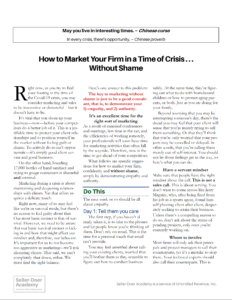
To read specific suggestions for how to market your firm, confidently and without shame, click here for the PDF.

Then click here to send me an email and tell me what you thought of it.

Be well and be safe. Jim

Report cover How to Market Your Firm During Coronavirus Crisis without Shame

Marketing Professional Services Without Shame During a Crisis (by Jim Rogers) revised

Filed Under: Accounting, Business Development, Communication, Construction, Generate Leads, Keep Clients, Professional Services Marketing, Sales, Seller-Doer

The Four Questions Every Seller-Doer Must Answer for Themselves

December 4, 2019 by Jim Rogers


Questions Seller-Doers Must Ask

If you’re a professional services principal, you rely on seller-doers to grow your business. We define a seller-doer as any billable professional who intentional acts to help generate revenue. These are typically professionals with 5-20 years of experience who have not yet reached rainmaker status.

Have you wondered about the keys to developing successful seller-doers? For many firms, dormant seller-doers are sitting there waiting to be unleashed.

Or if you’re ready to take your first step to become a seller-doer, do you wonder if you can do it and do you know where to start?

Or perhaps you’ve been a “sometimes” seller-doer with uneven results and a lot of headroom to grow.

If so, you may have wondered about the success factors for highly capable seller-doers.

In researching a book I’m co-writing on the topic of becoming a seller-doer, I’ve uncovered some clear keys to seller-doer success.

You can easily grasp the keys to success through the answers to four simple questions that seller-doers should ask themselves: Should I? Could I? Can I? Will I?

Let me pose them to you and then explain.

1. Should you?

Do you have the DESIRE to set out on the journey to becoming a seller-doer, or perhaps a better one than you are today? If you don’t have the motivation, then be content with the status quo.

There are many potential motivators: achievement, advancement, compensation, rewards and recognition, job security (as if), job satisfaction, and the intrinsic value of doing the work that you are passionate about. Some are better than others. [I’ll go into more detail in a later post.]

2. Could you?

Do you have enough BELIEF in yourself to begin the journey and to press on when you meet embarrassment or outright failure? If you don’t believe in yourself, then when you face obstacles or outright failure, you’ll trample desire as you retreat over it and to the safety of the status quo, where you feel most comfortable.

3. Can you?

Do you have or can you develop the ABILITY, that is, the knowledge, skills, and attributes for success? Unbelievably, this is the easy part if you know the learning strategies that work best.

4. Will you?

Will you have PERSEVERANCE? That is, will you face your fears and doubts? Will you accept failure as learning and be undaunted by it? Will you persist and make marketing and business development a habit and not merely a hobby?

Although it’s not a very catchy mnemonic, you can easily recall these four ingredients of success through the acronym DBAP.

Desire. Should I?

Belief. Could I?

Ability. Can I?

Perseverance. Will I?

In future articles, I’ll break down each of these questions a bit further and offer some advice that may help you.

Until then, if you aren’t yet a consistently successful seller-doer, ask yourself which question you’re stuck on right now.

Filed Under: Business Development, Seller-Doer

  • « Go to Previous Page
  • Page 1
  • Page 2
  • Page 3

Copyright © 2026 by Impellor Group, Inc. · (877) 358-8413